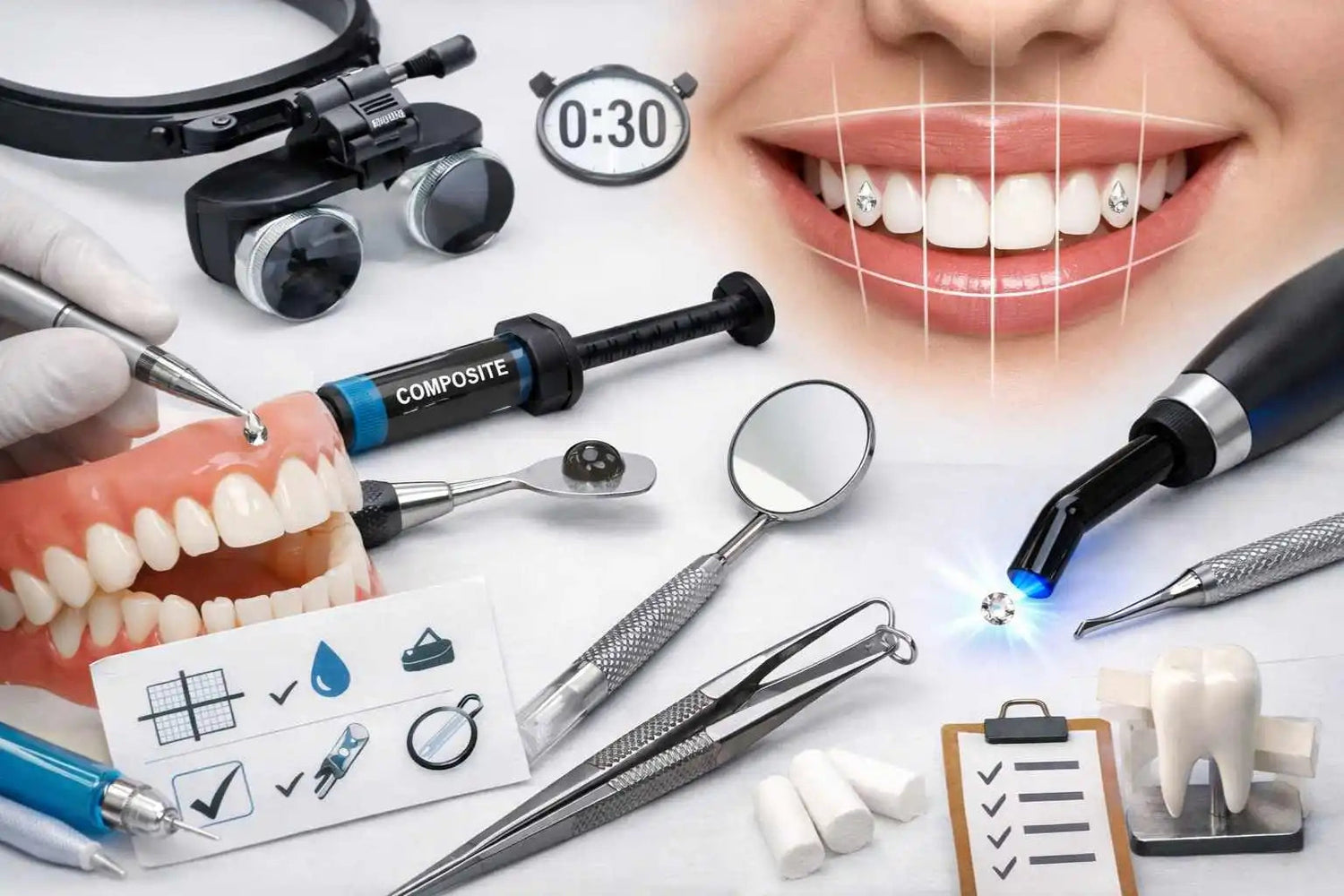
Quick answer: A consistent placement isn't some mysterious "knack"—it's a routine. Always work with reference points (axis, height, distances), a perfectly dry surface, a micro-dome of composite , and then a two-step placement process (place → stabilize → micro-adjust). By standardizing these steps, you gain precision , symmetry, and consistency, client after client.
Summary
- 1) What we call “regularity” (and why it goes haywire)
- 2) Visual cues: the grid that replaces “feeling”
- 3) Intelligent placement: aesthetics + occlusal logic
- 4) Dry field & isolation: precision begins before the jewel
- 5) Dosage & texture: mastering the composite to stabilize placement
- 6) Tools & technique: applying, releasing, correcting without shifting
- 7) Light, angle, posture: see correctly, hold correctly
- 8) Minute-by-minute protocol: the ritual of regular poses
- 9) Finishing & quality control: the “pro” effect is achieved here
- 10) Training: progress quickly without improvising
- Common mistakes
- Checklist / tips
- Recommendations
- FAQ
1) What we call “regularity” (and why it goes haywire)
Consistency is not synonymous with rigidity. It means achieving a repeatable result with the same level of sharpness, harmony, and sense of control. A consistent pose is one that "hits the mark" without requiring ten micro-corrections.
If your poses vary, it's rarely due to your talent. It's more likely an uncontrolled variation.
- a field not completely dry (the jewelry slips, you reposition it, you lose your bearings);
- a quantity of composite that changes from one application to another (too much = it floats, not enough = it moves);
- centering “by eye” instead of centering based on reference points ;
- too sudden a release (the jewel pivots at the critical moment);
- a control on a single angle (front view “perfect”, three-quarter view “crooked”).
The solution: reduce the variables. The goal is not to do more, but to do less, better, and always the same .
2) Visual cues: the grid that replaces “feeling”
When aiming for precision , intuition is replaced by a simple grid. A mental grid, easy to apply, that transforms "it looks centered" into "it's centered according to my reference points."
Reference point 1: the axis of the tooth
Visualize a vertical axis (neck → incisal edge). Your jewelry should follow the axis of the tooth, not the axis of your hand.
Reference point 2: the height (your standard)
Choose a rule and stick to it: “in the center,” “slightly above the center,” or “on a gentle diagonal,” depending on the desired effect. Regularity comes from a standard, not from a passing inspiration.
Reference point 3: the distance to the neck and the incisal edge
To avoid placing too close to the gum (often less visually comfortable and less practical in terms of hygiene) and to avoid the incisal edge (area of impact), set a “comfort” margin that you repeat systematically.
Reference point 4: two mandatory angles
Always confirm the pose from the front and slightly three-quarter angle. The truly accurate pose is the one that remains correct when you change the angle, not the one that reassures you from a single viewpoint.
3) Intelligent placement: aesthetics + occlusal logic
Precision isn't just about aesthetics. It's about minimizing areas at risk: repeated rubbing, impacts, bites, and tooth-to-tooth contact. Intelligent placement protects your results.
The key question: “Is this a contact zone?”
Before any application, ask yourself: is this area frequently used? If so, even a perfectly glued piece of jewelry will be subjected to more stress. You want an area that is both harmonious and mechanically calmer.
Harmony in a smile
A piece of jewelry never exists in isolation: it interacts with the line of the smile, the volume of the teeth, and the overall symmetry. Regularity also means aesthetic coherence: a placement that is immediately apparent.
Double poses: “same distances”, not “same impression”
For left/right symmetry, do not compare impressions (tiring and misleading). Compare distances: height, margin at the neck, margin at the incisive edge, and validate from the same angles.
4) Dry field & isolation: precision begins before the jewel
A wet field means a pose that slips. And a slippery pose forces you to make corrections. Each correction increases the chances of off-center exposure. A dry field guarantees precision.
The 30-second test
Before applying any product, ensure the area remains dry and stable for 30 seconds. If you fail this test, you may still succeed… but you'll be working against your own goal of consistency .
Anticipation: “everything must be ready”
Prepare your instruments, your jewelry, and your routine before you begin. The pose becomes irregular when you interrupt the flow: you lose your bearings, then you "find" it again by feel.
Micro tip for consistency
Keep the same setup, the same order, the same movement. Regularity often arises from a trivial detail: your hand no longer hesitates.
5) Dosage & texture: mastering the composite to stabilize placement
If you only had to master one thing to improve consistency , it would be the amount of composite material . Too much material = the jewelry feels loose. Not enough = it doesn't grip and shifts when released. The right amount makes placement almost effortless.
The “micro-dome”: your target shape
Aim for a small, localized dome, not a spread-out area. The jewel must be able to sit, stabilize, and then lock in place without drifting.
Why “less” often results in “more”
Less material = fewer smudges = fewer touch-ups = less risk of misalignment. The finish becomes cleaner, more elegant, more “high-end”.
The trap: correcting by sliding
When applying a large amount of composite resin, there's a tendency to slide the jewelry into the correct position. The problem is that the jewelry can continue to slip after your correction. Opt instead for short, controlled micro-pressures.
6) Tools & technique: applying, releasing, correcting without shifting
A piece of jewelry can be perfectly centered… until the moment you release it. Releasing it is a crucial step in itself. Consistency often depends on this moment, more so than on the initial placement.
The three-part approach: “position → stabilize → micro-adjust”
- To apply : bring the jewelry into contact without excessive pressure.
- Stabilize : 1 second of "calm" holding to prevent drift.
- Micro-adjust : correct with small pressures, not with long glides.
Controlled release
Release gently, without pulling. If your tool "sticks", you risk a slight misalignment that will be invisible at the time... but obvious in a photo.
Simple rule: limit movement
The more you move, the more you increase the risk. A regular pose is often a pose with few movements, but precise movements.
7) Light, angle, posture: see correctly, hold correctly
Precision is a matter of millimeters. Therefore, visibility and stability matter. And stability is as much a question of tools as of posture: a tense body results in a less consistent hand.
View the relief (not just the facade)
The tooth is not flat. A piece of jewelry can appear centered in 2D but be off-center in 3D. This is why the three-quarter view approval is non-negotiable.
Stable lighting = fewer illusions
Stable lighting reduces misleading shadows. Adjust the client's head position first, then the lighting, then your own. Your hand should land on a clear canvas, not a puzzle of shadows.
Neutral posture = repeatable gesture
The more neutral your posture, the more repeatable your movement becomes. Regularity is a natural consequence: less fatigue, less trembling, more consistency.
8) Minute-by-minute protocol: the ritual of regular poses
If you want consistent results, your routine must be consistent. This protocol is intentionally simple: it's meant to be repeated, not admired.
Step 1 — Landmarks (10–20 seconds)
- define the axis;
- choose the height;
- validate front + three-quarters.
Step 2 — Dry field (30–60 seconds)
- isolate;
- check for stability;
- Have all your equipment ready within easy reach.
Step 3 — Preparation (same sequence)
Follow your sequence (surface preparation, adhesion steps) and maintain the same logic each time. Consistency comes from a predictable process.
Step 4 — Composite (micro-dome) deposition
- deposit a micro-quantity;
- avoid spreading;
- aim for a stable point.
Step 5 — Placement & Locking
- to set down ;
- stabilize for 1 second;
- micro-adjust;
- re-validate on 2 angles;
- polymerize without moving.
9) Finishing & quality control: the “pro” effect is achieved here
A consistent installation is evident in its finish. This is often what separates a "nice" installation from a "premium" one. The finish is all about clean lines: no excess, no "busy" effect, no visual edges.
3-point quality control
- Alignment : the jewelry respects the axis of the tooth.
- Distances : consistent and comfortable margin, harmonious placement.
- Finish : clean outline, light finish, sharp effect in photos.
The trap: “it’ll be fine”
Consistency isn't lost with one big mistake. It's lost with small "it'll do"s. Maintain a simple and consistent standard, even when you're in a hurry: that's the secret to poses that stay beautiful... all the time.
10) Training: progress quickly without improvising
Precision is built up. And the fastest way is to make your training sessions comparable: same type of pose, same reference points, same success criteria. You're not aiming to "succeed once." You're aiming to succeed often .
Exercise 1: Repetition “same reference points”
Repeat a simple pose, keeping the same height and margin. Compare the results: if they vary, it means that one variable (dryness, quantity, relaxation) is not stable.
Exercise 2: Mandatory validation at 2 angles
Force yourself to validate each pose from two angles. After a few sessions, your eye will "correct beforehand" and your hand will follow.
Exercise 3: Reduce the number of corrections
Objective: to place accurately from the first contact, then make minimal adjustments. Fewer movements = greater consistency.
To build a method (rather than a collection of tips)
What makes a professional consistent is a system: benchmarks, routine, dosage, quality control. Tricks alone are not enough if the system is not stable.
Common mistakes (10)
- Place by feel : no reference points = variable result.
- Control on a single angle : centered from the front, off-center in relief.
- Field not dry enough : slippage, repositioning, loss of bearings.
- Too much composite : jewelry that floats, misalignment when loosened.
- Spread composite : placement “over an area”, not on a point.
- Releasing too quickly : rotation or mini-shift at the critical moment.
- Over-correcting : more manipulations = more risks.
- Do not standardize your routine : one pose = one different method.
- Posture under tension : trembling and a drop in precision at the end of the session.
- Neglecting the finish : excess, "busy" look, defects visible in photos.
Checklist / tips (safe)
- I set my reference points before starting: axis + height + distances.
- I always approve the placement on 2 angles: front + three-quarters .
- I secure a dry field (30-second test if needed).
- I prepare all my equipment within easy reach to avoid interruptions.
- I deposit a micro-quantity of composite in a micro-dome.
- I place: apply → stabilize for 1 second → micro-adjust → re-validate → polymerize.
- I limit my movements: I aim for accuracy on the first contact.
- I do a final quality check: alignment , distances , finish .
- I note what has varied if the pose seems less regular (dryness, quantity, relaxation, angle).


Leave a comment
This site is protected by hCaptcha and the hCaptcha Privacy Policy and Terms of Service apply.