

Quick answer: poor tooth gem retention is not always caused by the gem itself. The problem may lie with the application equipment, its condition, storage or use: a poorly positioned lamp, moisture, unsuitable accessories, disorganized consumables, inconsistent amounts of product or a missing final check. To reduce failures, standardize the workstation, check the tools and use the products according to a consistent method.
This guide covers common mistakes with application equipment and practical habits for cleaner work.
Contents
- Blaming the product without analyzing the protocol
- Preparing the workstation too quickly
- Underestimating isolation
- Using the lamp incorrectly
- Neglecting tool maintenance
- Poor consumable management
- Using too much or too little product
- Choosing unsuitable accessories
- Forgetting quality control
- Equipment checklist
- FAQ
1. Blaming the product without analyzing the protocol
When a tooth gem does not stay in place, the first reaction is often to blame the gem, adhesive or lamp. However, retention depends on a full chain: preparation, moisture, quantity, placement, curing and aftercare.
Before changing products, it is important to check that the method is consistent and that the equipment is used correctly.
2. Preparing the workstation too quickly
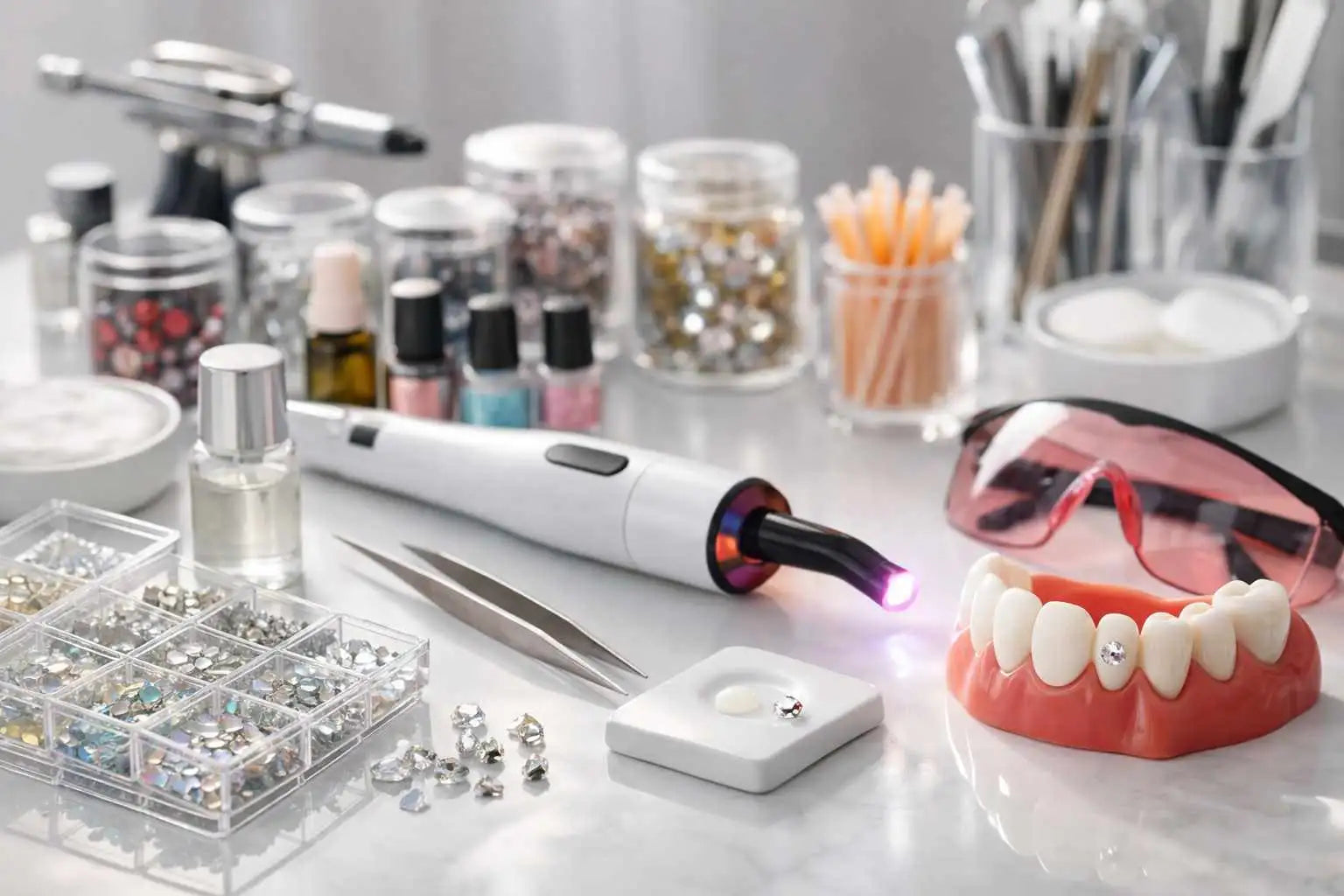
A workstation that looks ready is not always truly ready. Tools should be accessible, consumables organized, the lamp available and the work area clean.
A poorly prepared workstation creates interruptions, increases handling and can reduce precision.
3. Underestimating isolation
Moisture is one of the most common causes of failure. Even with a good product, a poorly isolated area can reduce the gem’s retention.
Interruptions should be limited, the surface kept as dry as possible and unnecessary handling avoided.
4. Using the lamp incorrectly
A lamp that turns on is not necessarily used correctly. Distance, angle, stability and exposure time should remain consistent.
- Do not hold the lamp too far away.
- Avoid imprecise angles.
- Keep your hand steady.
- Follow the duration required by the protocol.
- Check that nothing casts a shadow over the area.
5. Neglecting tool maintenance
Application tools should remain clean, organized and in good condition. A dirty tip, worn tool or poorly maintained workstation can affect precision and hygiene.
Regular maintenance also makes it easier to identify the real cause if retention varies.
6. Poor consumable management
Consumables should be stored correctly, protected from heat, humidity and contamination. A poorly stored product or one left open too long can become less reliable.
Good management relies on simple stock rotation, organized storage and regular checks.
7. Using too much or too little product
Dosage affects the final result. Too much product can create visible excess, while too little can make the gem less secure.
The best approach is to work with a small, controlled amount that can be applied consistently.
8. Choosing unsuitable accessories
Accessories should match the gem size and intended technique. A tool that lacks precision can cause drops, repositioning and extra handling.
Keeping handling to a minimum makes application smoother and cleaner.
9. Forgetting quality control
The final check helps identify excess, misalignment, comfort issues or areas to monitor. It should not be optional.
- Check placement.
- Check around the edges of the gem.
- Confirm comfort.
- Share aftercare advice.
Equipment checklist
- The workstation is clean and organized.
- Accessories are ready before starting.
- The lamp is available and used at the right distance.
- Consumables are clean and well stored.
- The area is isolated and dry.
- Dosage is controlled.
- The tooth gem is placed with minimal handling.
- The final check is performed.
- Aftercare advice is shared.
Recommended reading
FAQ
Why does a tooth gem fall off quickly?
Possible causes include moisture, insufficient preparation, poor placement, irregular dosage, incorrect lamp use or insufficient aftercare.
Can the lamp be the issue?
Yes, especially if it is too far away, poorly angled or not held steadily. Protocol consistency matters.
Should you change products as soon as an application does not hold?
Not necessarily. First analyze the protocol, isolation, dosage, lamp and aftercare before deciding that the product is responsible.
How can equipment mistakes be avoided?
By preparing the workstation before application, checking tools, storing consumables correctly and following a consistent routine.
Why is the final check important?
It helps spot poor placement, visible excess or comfort issues before the client leaves.
Conclusion
Tooth gem application equipment involves more than just the products used: it also includes the workstation, tools, lamp, consumables, method and final check. A clean, consistent and well-organized routine reduces mistakes and helps achieve more consistent results.


Leave a comment
This site is protected by hCaptcha and the hCaptcha Privacy Policy and Terms of Service apply.