

Quick answer: choose tooth gem size using its actual dimensions, the visible width of the tooth, placement and the space needed for cleaning around it. An enlarged photo or labels such as “small”, “medium” or “large” are not enough.
This guide supports an aesthetic and practical decision. It does not determine whether a tooth is suitable for a gem; ask a dentist if there is any uncertainty.
1. Start with actual dimensions
Compare measurements in millimetres, not only product images. The same size label may refer to different dimensions depending on shape or supplier.
- For a round gem, check diameter.
- For a shape, check width, height and orientation.
- For a raised gem, consider thickness as well.
- For a composition, include spacing between elements rather than adding only their dimensions.
2. Compare with the tooth and smile
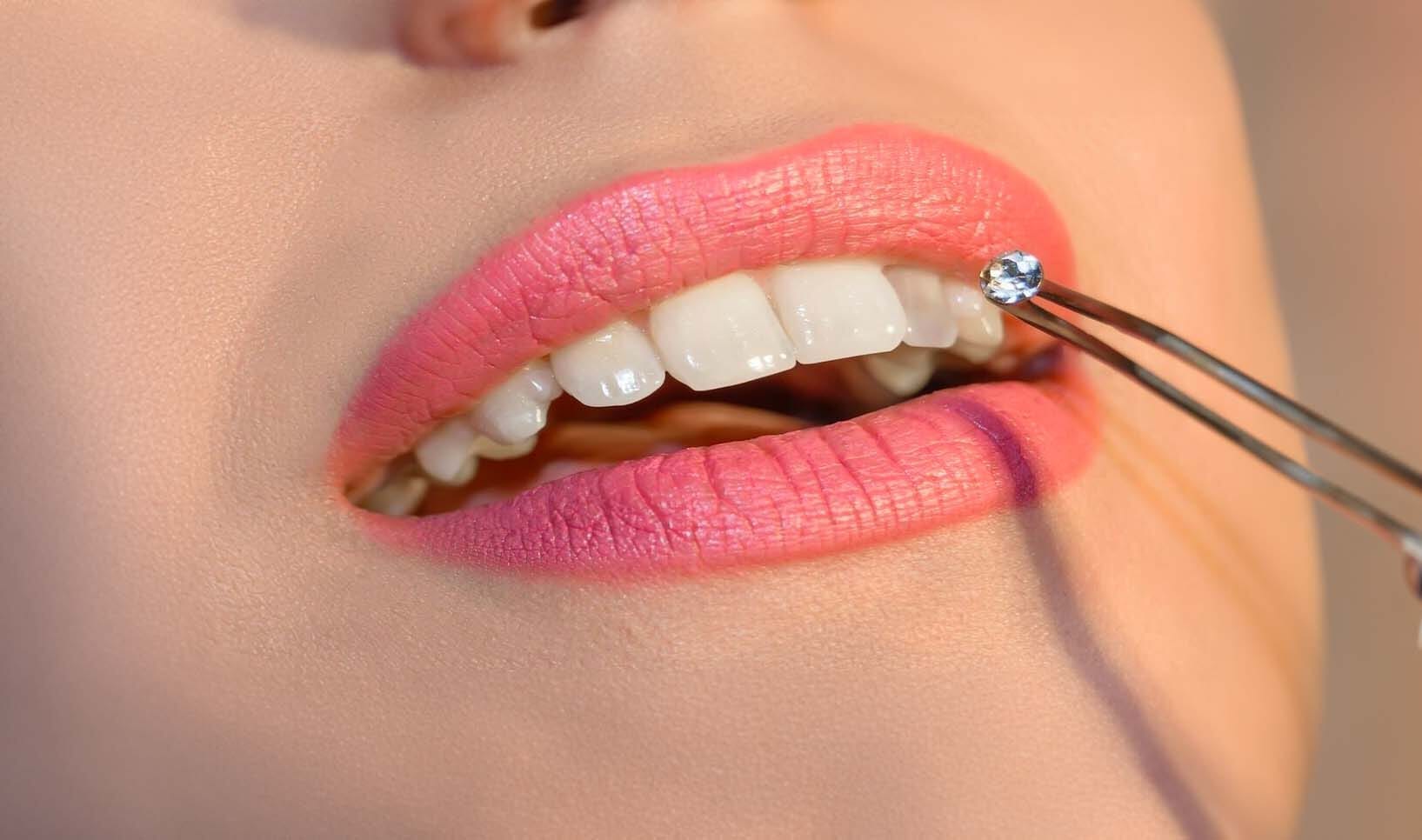
The same gem looks different on a broad incisor, canine or smaller tooth. The aim is not to fill the surface, but to keep a legible proportion, avoid the gum and tooth edge, and leave the surrounding area accessible for cleaning.
Before deciding, view the smile from the front and three-quarter angle and with the mouth closed to assess visibility and lip contact.
3. Choose for the intended effect
- Discreet: one element that does not visually dominate.
- Point of light: a central gem proportionate to the tooth.
- Recognizable shape: large enough to read without overwhelming the surface.
- Composition: several sizes arranged in a hierarchy with regular spacing.
- Signature: one focal element with smaller accents, without sacrificing cleanability.
4. Test placement before bonding
- Record the gem’s dimensions.
- Create a true-to-scale reference or mock-up.
- Compare several positions without bonding.
- Check distance from the gum, tooth edge and contact areas.
- View the design at a normal distance, not only in close-up.
- Confirm that the surrounding edge can be cleaned.
The placement ideas provide inspiration, not clinical approval.
5. Combine several sizes
A clear composition creates hierarchy: one element draws attention and the others support it. Too many equal-size pieces may make the design heavy, while too little space may make the edge difficult to clean.
- Define the focal point first.
- Add one element at a time.
- Keep spacing consistent.
- Review the whole smile.
- Stop before the composition loses legibility.
Common mistakes
- Choosing from a macro photograph alone.
- Confusing diameter with the total dimensions of a shape.
- Positioning too close to the gum or tooth edge.
- Overloading a small tooth.
- Ignoring thickness and lip contact.
- Creating a composition that cannot be cleaned properly.
Cleaning and placement considerations are explained in the hygiene and safety guide.
Collections and reading path
- Tooth gems: compare classic looks.
- Shaped gems: check width, height and orientation.
- Complete guide: place size within the overall choice.
- Pre-application checklist: review conditions before deciding.
Frequently asked questions
Which size should I choose for a first composition?
Start with few elements and compare their actual dimensions with the tooth. Simplicity makes placement and cleaning easier to assess.
Does a large gem have poorer retention?
Size alone cannot predict retention. A bulkier piece may be more exposed to contact and impact depending on placement.
Can several sizes be combined?
Yes, if visual hierarchy, spacing and cleaning remain coherent.
Are shapes selected like rounds?
No. Consider width, height, orientation and profile rather than a single diameter.
Editorial method and limits
This method uses verifiable criteria: dimensions, proportion, placement, legibility and cleanability. Oral-health precautions are consistent with guidance from the American Dental Association and Oral Health Foundation.
Tooth Gems World editorial content, updated September 4, 2026. Sources accessed September 4, 2026. Aesthetic choice does not replace assessment of tooth health.

Leave a comment
This site is protected by hCaptcha and the hCaptcha Privacy Policy and Terms of Service apply.