Summary
- Why a dental jewel changes the game in terms of hygiene
- Risk overview: understanding what's really happening
- Before the procedure: questions to ask + contraindications
- Allergic reactions: how to prevent them (practical advice)
- Daily hygiene: a complete and smart routine
- Diet & Habits: The “Little Things” That Create Big Problems
- Warning signs: when to stop and seek medical help
- Duration, control, withdrawal: securing the sequel
- Jewelry quality: what really matters for safety
- Common mistakes
- Safety checklist
- Recommendations (links)
- FAQ
1) Why a dental jewel changes the game in terms of hygiene
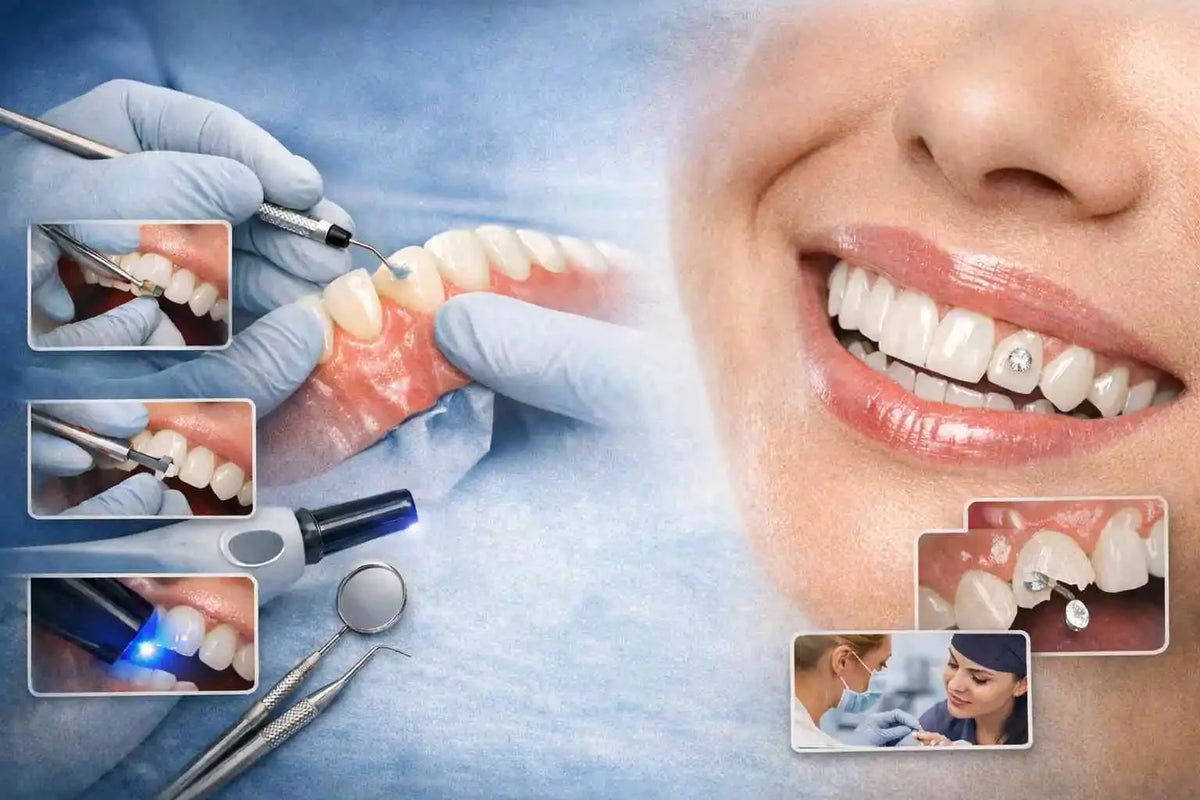
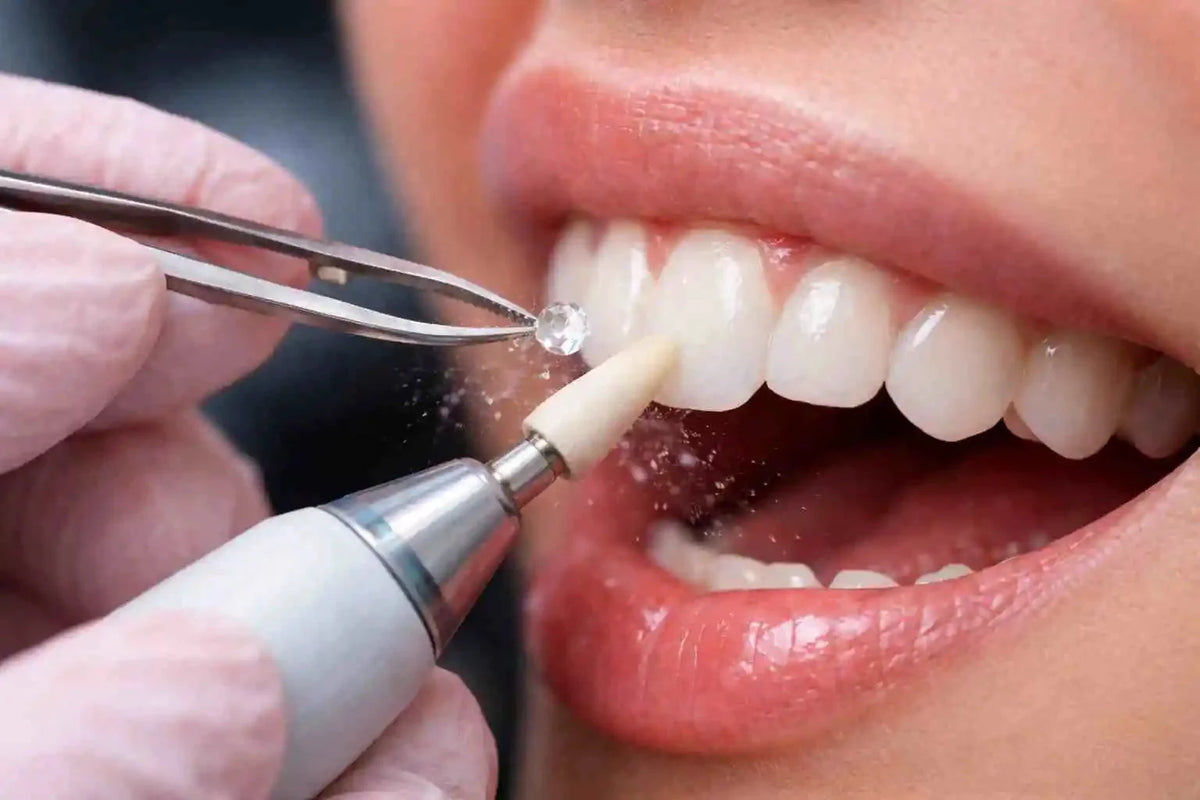
To the naked eye, a dental rhinestone appears tiny. But for the mouth, it acts like a micro-relief added to a normally smooth surface. And anything that creates relief also creates an area where plaque likes to accumulate.
Plaque isn't "dirty" in a moral sense; it's a natural bacterial film. The problem arises when it isn't removed properly. Around jewelry, cleaning needs to be more precise because bacteria easily accumulate on the edges, making the area harder to reach with a quick brush.
In short: the jewelry itself isn't necessarily the danger. The danger lies in wearing jewelry while maintaining only minimal hygiene.
2) Risk overview: understanding what is really happening
2.1 Plaque accumulation, caries and gingival inflammation
This is the number one risk, and it's often silent. When plaque builds up at the edge of the jewelry, it can cause:
- Gingivitis : red, sensitive gums, bleeding when brushing.
- Halitosis (bad breath): sometimes linked to an area that is difficult to clean.
- Tooth decay : if bacteria remain in contact with the enamel for a long time, especially with frequent consumption of sugary/acidic foods.
This risk increases if the jewelry is close to the gum, if you already tend to build up tartar, or if you skip interdental cleaning.
2.2 Mucosal irritations (lips/cheek)
Irritation doesn't always occur on the first day. Sometimes, it's subtle, repeated friction that eventually inflames the mucous membrane. Typical signs:
- a small wound that always recurs in the same place.
- a feeling of engagement when you speak or smile.
- localized discomfort upon contact with the jewelry.
The thicker, more angular, or poorly positioned a piece of jewelry is, the more irritating it can become. It's not "all in your head": the mouth is one of the most sensitive areas of the body.
2.3 Tooth sensitivity, enamel weakening
Enamel is strong, but not invincible. Some teeth already have weaknesses: white spots (demineralization), micro-cracks, hypersensitivity to cold, or a history of cavities. In these cases, any cosmetic procedure must be considered with greater caution.
The critical point is not the aesthetics themselves: it's the way the tooth is prepared and how the jewelry is removed/replaced if necessary. This is where experience and precision play a role.
2.4 Detachment, ingestion and aspiration
A piece of jewelry that comes loose can:
- to be swallowed (often without consequence),
- to get stuck and irritate the mucous membrane,
- more rarely, it can be inhaled (a rare but serious scenario).
Prevention here means a secure fastening, and above all a simple attitude: if the jewelry moves, you don't "put up with it". You deal with the problem right away.
3) Before installation: practical precautions + questions to ask
Before wearing dental jewelry, the right thing to do is to check two things: the condition of your teeth/gums, and your mastery of the products used.
3.1 Profiles and situations where greater caution is required
- Avoid if you have: active cavities, unexplained pain, regularly bleeding gums, significant tartar buildup, oral infection, active periodontal disease.
- Increased caution if you have: a veneer/crown on the affected tooth, orthodontics, bruxism, very sensitive enamel, a history of allergic reactions (cosmetics, jewelry, glues, resins).
3.2 Safety questions to ask your professional
If you want to reduce the risks, here are some useful questions to ask beforehand :
- What exact products are used (name, type, and use)?
- Could you please provide me with the composition or product information sheet (at a minimum: type of resin/adhesive, presence of known irritants)?
- How can you be sure that the tooth is suitable (no decay, healthy gums)?
- What do you do if the person has an allergic reaction (nickel, resins, glues, latex)?
- How do you handle a removal if the jewelry is uncomfortable or if irritation occurs?
The idea is not to be “suspicious”. The idea is to be informed: a serious professional will answer you clearly and directly.
4) Allergic reactions: prevention (very practical)
When discussing allergic reactions to dental jewelry , two main categories of causes are most frequently cited:
- The material of the jewelry (metals, alloys, surface treatments).
- Products used around the tooth (resins/adhesives, primers, conditioning agents, gloves, disinfectants).
4.1 What you can do BEFORE to limit the risk
- Disclose your history : if you have ever reacted to jewelry, nail glues, resins, latex, or certain cosmetics, state it clearly.
- Ask for the list of products used and, if possible, the reference: this allows you to check with your dentist or the professional who installed these products if they are suitable for your profile.
- Check the materials : if you are known to have a metal allergy (e.g., nickel), ask for compatible jewelry and avoid uncertain materials.
- If in doubt : seek advice from an oral health professional before fitting, especially if you have previously experienced an allergic reaction in the mouth.
Important point: an allergy is not always immediate. Some reactions appear after several hours or days, once the mucous membrane is repeatedly exposed.
4.2 How to recognize a reaction (vs. simple discomfort)
Slight discomfort may occur at first (a new sensation). However, these signs should raise concern:
- local swelling (lip, gum, mucous membrane),
- burning , itching, abnormal heat sensation,
- intense redness that spreads,
- small lesions that appear rapidly near the contact area,
- symptoms that are increasing day by day instead of decreasing.
In this case: avoid any home remedies, contact a professional quickly, and don't wait for it to "go away".
5) Daily hygiene: a complete and intelligent routine
With dental jewelry, the key word is consistency . A day "without serious brushing" has a greater impact when there is an area where plaque easily adheres.
5.1 Brushing: precision without aggressiveness
- Soft brush : to avoid irritating the gums and damaging the enamel.
- Gentle gestures : 30 seconds of careful brushing around the jewelry is better than a harsh brushing.
- Local pressure : gently run the polish around the edges of the jewelry, without trying to “peel” it off.
5.2 Interdental cleaning: the forgotten step that changes everything
Many gum problems don't stem from the jewelry itself, but from a lack of cleaning between the teeth. With jewelry, this is even more important: you want to minimize the overall bacterial load.
- Dental floss or interdental brushes: choose what suits you and stick to it.
- If your gums bleed initially, this could be a sign of pre-existing inflammation. If it persists, get it checked out.
5.3 Mouthwash: useful, but not “magical”
A mouthwash can complement a routine, but it doesn't replace proper oral hygiene. If you use one, prioritize the logical approach: clean first , then complete the process. And if you plan on using antiseptic products for an extended period, consult a professional.
6) Diet & habits: what destabilizes (and promotes problems)
The mouth is not a stable environment: temperature, acidity, shocks, friction… Jewelry has to "live" in that environment. Certain habits greatly increase the risk of detachment and therefore irritation:
- to bite into very hard foods with the incisors,
- sticky candies and very sticky chewing gum,
- chewing on pens/caps, opening packages with their teeth,
- bruxism (nocturnal grinding): repeated micro-shocks.
And regarding cavities: it's not "the jewelry" that creates sugar, but the combination of frequent sugar + imperfect cleaning that can become problematic around a retention area.
7) Warning signs: when to stop and seek medical help (without delay)
A dental jewel should not be accompanied by persistent pain. Signs to take seriously:
- new pain or sensitivity (hot/cold) in the affected tooth,
- red, swollen gums, or gums that bleed easily near the jewelry,
- Unusual bad breath despite good hygiene.
- jewelry that moves , catches, or gives the sensation that it “lifts up”,
- Mucosal irritation that recurs daily in the same place.
- signs consistent with an allergic reaction (swelling, burning, diffuse redness).
The right thing to do: stop “overcompensating” (aggressive brushing, scratching), and seek professional advice.
8) Duration, control, withdrawal: securing the future
A dental jewel is an accessory, not a lifelong commitment. Safety also depends on what happens afterward.
- Check : If you keep the jewelry for a long time, regularly check that the area remains clean and that the gum is healthy.
- Removal : If you need to remove the jewelry, choose a suitable removal method to limit any unnecessary risk to the enamel .
- Replacement : If the tooth becomes sensitive or the gum becomes irritated, take a break and have it checked before replacing the jewelry.
The best aesthetic is the one that doesn't cost your smile anything.
9) Jewelry quality: what really matters for hygiene
Dental jewelry is often chosen for the light it reflects. But from a hygiene perspective, the essential criteria are more "technical":
- Smooth finish : fewer imperfections = less plaque adhesion and less irritation.
- Controlled thickness : the more discreet it is, the easier it is to live with on a daily basis.
- Stability : a reliable fit reduces the risk of detachment and therefore ingestion/irritation.
In other words: “beautiful” must also be “clean”.
Common mistakes (to be absolutely avoided)
- Neglecting oral hygiene because the jewelry is small.
- To tell oneself that bleeding gums are “normal”.
- Brushing too hard to “compensate” (irritation + unnecessary aggression).
- Ignore a piece of jewelry that moves or catches.
- Attempting to remove/reattach it yourself (risk to enamel and mucous membrane).
- Crunching hard foods with the front teeth out of habit.
- Minimize a possible allergic reaction (swelling, burning, redness).
- Keeping the jewelry for months without ever checking the condition of the gums.
- To think that mouthwash replaces mechanical cleaning.
- To continue despite a sensitivity that is gradually setting in.
Safety checklist: before / after
Before
- Teeth and gums: healthy (no pain, no bleeding, no suspected cavities).
- Allergic conditions: inform the professional and check the composition of the products used.
- If veneer/crown, fragile enamel or doubt: seek advice from an oral health professional.
- Understanding withdrawal management: what to do if there is discomfort, irritation, or peeling.
After
- Gentle and precise brushing around the jewelry, twice a day.
- Interdental cleaning: stable routine (floss/brushes).
- Limit hard/sticky foods with the incisors.
- Monitor: gums, sensitivity, stability of the jewelry.
- If in doubt: do not handle, consult a doctor.
Recommendations
- Everything you need to know about dental jewelry (definition, styles, choices)
- Buy high-quality dental rhinestones
- Procedure for a pose and points to consider (overview)
FAQ
Is dental jewelry dangerous?
It's not necessarily dangerous, but it does require precautions . The most common risk is plaque buildup around the jewelry if hygiene isn't maintained. Other risks include irritation, sensitivity, allergies, and detachment.
How to prevent an allergic reaction?
By being transparent about your medical history, requesting a list of products, and verifying their ingredients with your healthcare professional (or your dentist if you have allergies), you should exercise extreme caution. If you have a history of allergies (to jewelry, glues, resins), you must be extremely careful.
What signs should prompt you to seek medical help quickly?
Swelling, burning, spreading redness, persistent pain, bleeding gums, loose jewelry, repeated irritation of the lip or cheek. These are signs that should not be ignored.
Does dental jewelry damage enamel?
The risk depends primarily on the initial condition of the enamel and the management of the insertion/removal procedure. Extra caution is advised on a weakened or very sensitive tooth. If in doubt, seek dental advice beforehand.
How to clean around a dental rhinestone on a daily basis?
Gentle and precise brushing around the jewelry, plus regular interdental cleaning. The goal is to prevent plaque buildup around the edge of the jewelry, without ever aggressively "scraping".
What should I do if the jewelry comes loose?
Do not attempt to reattach it yourself. A detached piece of jewelry can be swallowed or cause irritation. If you experience any unusual discomfort (coughing, pain, a foreign object sensation), consult a doctor promptly.
Is it safe to wear dental jewelry if you have sensitive gums?
If your gums are inflamed or bleeding, it's best to stabilize the situation first. Jewelry can complicate local cleaning and worsen the inflammation.
How long should you keep a dental jewel in?
There is no universal duration. The safest approach is to monitor hygiene, the stability of the jewelry and the condition of the gums over time, and not hesitate to have it checked if you wear it for a long time.


Leave a comment
This site is protected by hCaptcha and the hCaptcha Privacy Policy and Terms of Service apply.