Quick answer:
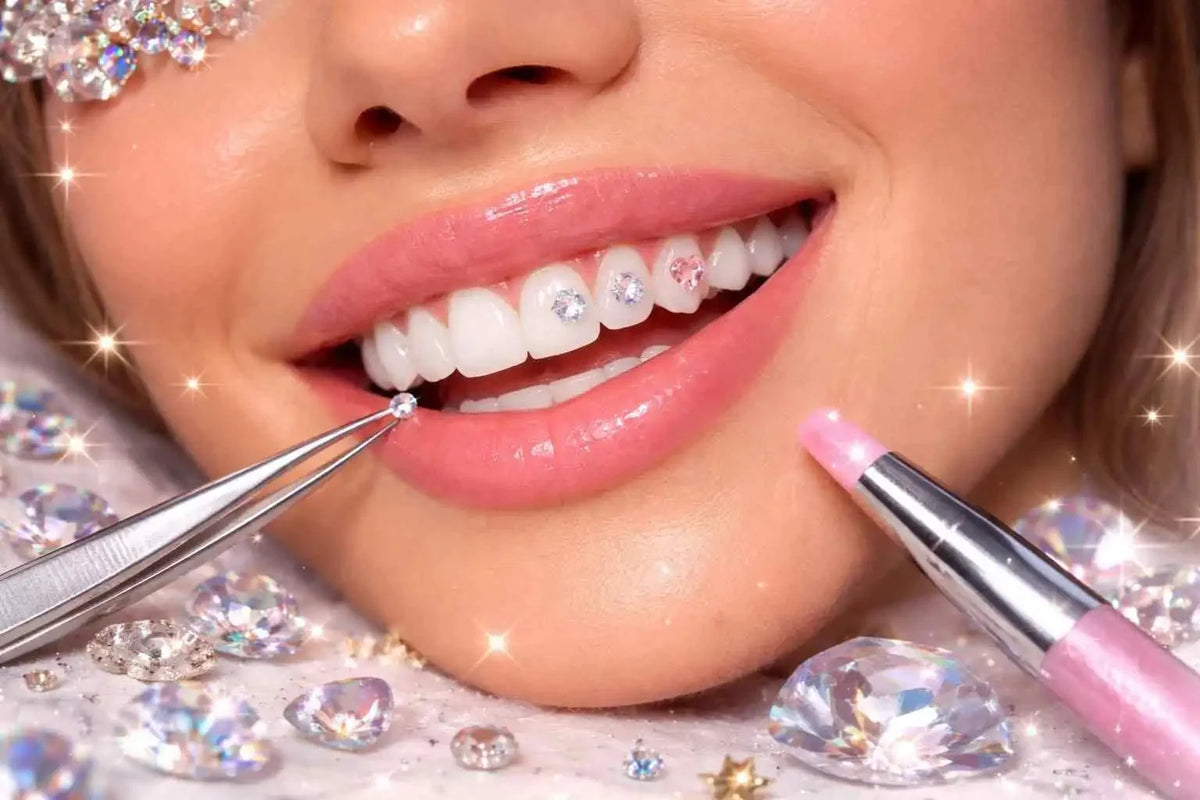
DIY tooth gem kits allow you to explore different placement ideas : a single, discreet gem, a symmetrical pair, central compositions, or more creative designs. The best placement depends primarily on the balance of your smile, the chosen tooth, and the desired level of visibility.
Discover DIY kits: placement ideas to enhance your smile
A tooth gem may seem tiny, almost imperceptible. Yet, placed in the right spot, it instantly transforms the look of a smile: it catches the light, highlights a line, accentuates a tooth, and adds a touch of character. The secret lies not only in the sparkle or size of the gem, but also in its placement.
DIY kits have precisely this advantage: they offer a simple entry point for visualizing different styles and choosing, in advance, a placement that reflects one's personality. Some seek a chic and discreet detail, others a bold signature, almost a stage jewel. In between, there is a multitude of nuances.
In this guide, you will find concrete ideas inspired by the most popular placements: from minimalist compositions to bolder designs, with tips to maintain a harmonious and elegant look.
Summary
- Placement: what really changes the look
- Minimalist placements: the elegance of a single rhinestone
- Controlled asymmetry: a detail that catches the eye
- Central placements: the most visible option
- Compositions with multiple rhinestones: balance and rhythm
- Patterns and shapes: star, butterfly, creative designs
- Colors and reflections: how to influence the final effect
- Adjusting the placement to match your smile: what makes the difference
- Common mistakes to avoid
- Checklist & tips (safe)
- Recommendations
- FAQ
Placement: what really changes the look
A smile isn't a fixed surface: it moves, creases, and reveals itself more or less depending on the expression. This is why the same rhinestone can appear ultra-discreet on one person and very noticeable on another. Placement determines:
- the area of the smile most exposed to light,
- the level of attention (discreet vs assertive),
- the impression of balance (symmetry, center, offset),
- overall consistency with the style (natural, chic, creative).
In short: a good investment isn't "too" noticeable. It's just noticeable enough, like a valuable detail.
Minimalist placements: the elegance of a single rhinestone
The most timeless placement remains the single rhinestone . It's the choice of those who appreciate refined details: a touch of light, without being overwhelming. It blends easily into everyday life, doesn't tire the eyes, and transcends trends.
On the lateral incisor: the most elegant choice
The lateral incisor is often the most harmonious option. It's visible when you smile, but rarely "in the center," which gives a naturally elegant look. The rhinestone catches the light without creating an overly dominant focal point.
Ideal if: you want a discreet, feminine look that's easy to wear everywhere.
On the canine tooth: a slightly more pronounced signature
The canine tooth has a stronger visual presence. A rhinestone on the canine attracts more attention and adds a touch of "statement" without being excessive, especially with a classic round rhinestone.
Ideal if: you want a visible detail, but still elegant.
Controlled asymmetry: a detail that catches the eye
Asymmetry, when intentional, creates an impression of modernity. A rhinestone placed on only one side of the smile gives a feeling of controlled style, like a single earring or a ring worn on only one finger: it is not “unbalanced”, it is a choice.
This type of placement works particularly well when the rhinestone is simple (round shape, luminous reflections) and when the overall smile remains "breathable." The eye immediately understands the intention: a point of light, a signature, a wink.
Aesthetic tip: if you opt for asymmetry, avoid adding too many other visual elements (heavy lipstick + multiple rhinestones + a pattern, for example). Elegance often comes from simplicity.
Central placements: the most visible option
A central placement is instantly noticeable. It's the most "jewel-like" option: it draws the eye with the first smile, like a statement piece. On designs with multiple rhinestones, you sometimes see alignments (vertical or horizontal) that structure the center of the smile.
This choice is superb when it's clean and consistent, but it requires a real search for harmony: the center is an area where the human eye quickly detects what's not aligned. That's why many prefer to start with a lateral placement, then move towards central compositions once they better understand the desired effect.
Ideal if: you want a very visible, bold result with a real impact.
Compositions with multiple rhinestones: balance and rhythm
When you go from one to two, three, four rhinestones or more, you're not just changing the quantity: you're changing the logic. Starting with two rhinestones, you create a composition . And a composition must have rhythm.
Symmetrical duo: clean, neat, harmonious
Two rhinestones placed symmetrically (for example, on either side of the center, or on two mirror-image teeth) create a very balanced look. This is often the safest option when you want to add a little more presence without creating an overly busy effect.
Three rhinestones: the design becomes more graphic
With three rhinestones, the effect can become more structured: a small line, a visual triangle, a more "designer" look. This works very well if the rhinestones remain consistent (same style, same brilliance, same theme).
Four rhinestones or more: what matters is the look.
Denser compositions should still feel airy. The trap is wanting to "fill" the space: what makes a design beautiful is often the space left around it. An elegant arrangement is more memorable than an accumulation.
Patterns and shapes: star, butterfly, creative designs
The motifs (star, butterfly, more original shapes) do not convey the same message as a round rhinestone. A circle suggests simplicity and timelessness; a motif conveys an intention: softness, whimsy, glamour, a “couture jewelry” feel.
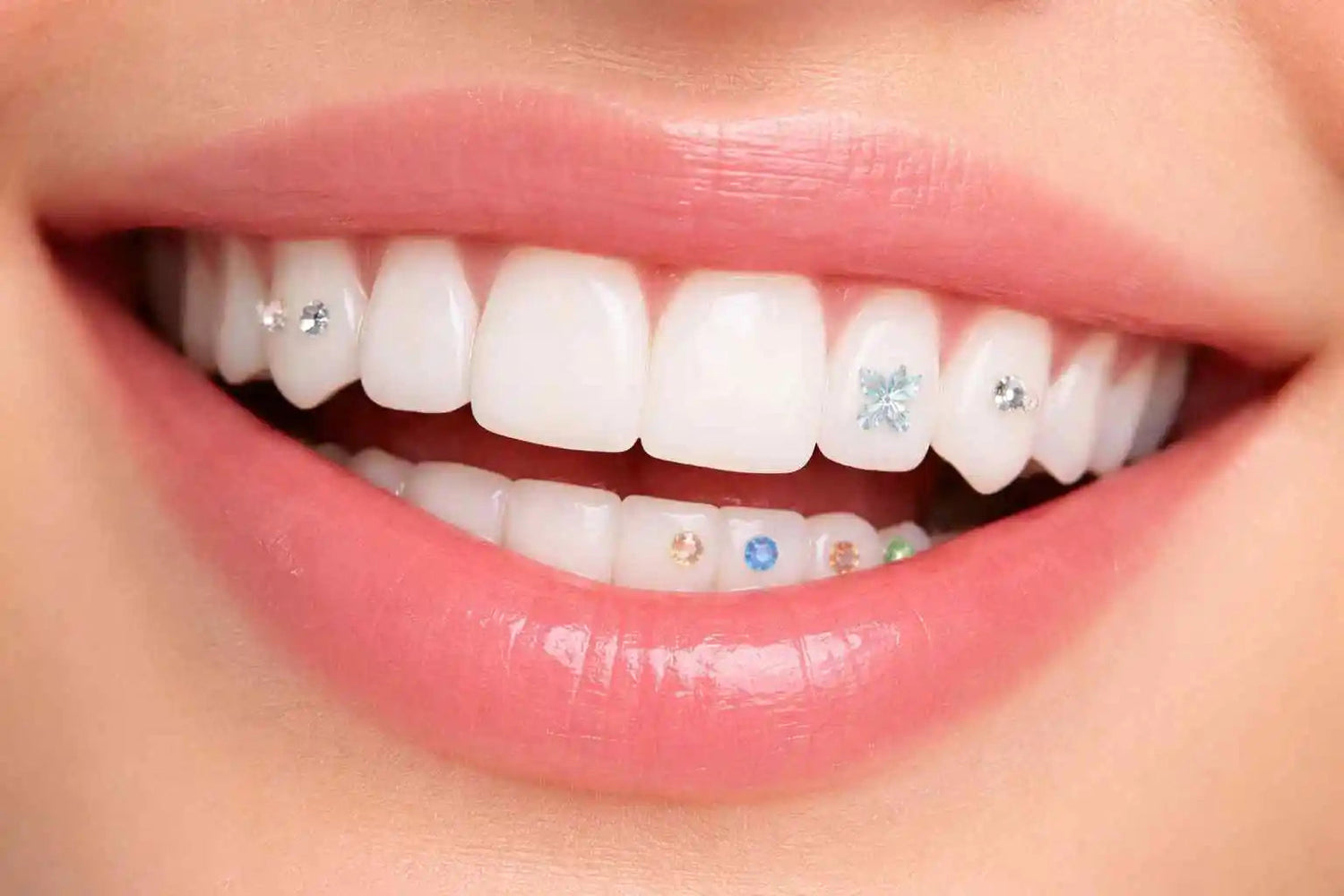
A butterfly immediately catches the eye because it's perceived as a shape, not just a sparkle. A star can add a pop of color or a touch of playful luxury, depending on its color and size. These designs look stunning when used as the focal point, without too many competing elements.
Aesthetic tip: a design works best when it stands alone or is accompanied by very few secondary rhinestones. The goal is for the design to be understood at first glance.
Colors and reflections: how to influence the final effect
Color changes the perceived intensity. A clear or transparent rhinestone blends in more easily and gives a "natural light" effect. A colored rhinestone becomes an accent: it catches the eye more quickly, even if it is small.
This is precisely what we notice in designs with multiple colors: the composition becomes more expressive, almost like "premium costume jewelry." It can be stunning… provided it's consistent with the overall style we're aiming for.
Simple rule: the more colorful it is, the more minimalist you should be on placement.
Adjusting the placement to match your smile: what makes the difference
There is no such thing as a "universal" placement. Two people can choose the same design and get a different result, simply because:
- the teeth are not all the same shape (wider, thinner, more rounded),
- The smile reveals more or less of the canines or incisors.
- light is not reflected in the same place depending on the alignment.
That's why inspiration should remain just that: inspiration. The best placement is the one that respects your smile, your style, and your desire for visibility.
Common mistakes to avoid
- Choosing a placement solely because it's trendy, without considering its smile
- Accumulating too many rhinestones in a very small area
- Placing a motif (star/butterfly) on a narrow tooth flattens the shape
- Create a composition without rhythm (rhinestones “placed randomly”)
- Trying to make everything visible: sometimes, subtlety is more luxurious
- Mixing too many colors or too many styles in the same composition
- Choosing a very busy center when we initially wanted something discreet
- Forgetting that facial expression changes the perception of placement
Checklist & tips (safe)
- First, decide on the level of visibility: discreet , balanced , or highly visible.
- Choose an area: lateral incisor (chic), canine (assertive), center (impact)
- Leave some space: a design breathes better than an accumulation
- If you're hesitant: start with a minimalist investment and progress gradually.
- Avoid layering too many effects (pattern + colors + multiple rhinestones) if you want an elegant result.
Recommendations
FAQ – Placement ideas with a DIY kit
What placement should I choose for my first rhinestone?
A single rhinestone on the lateral incisor is often the most elegant and easiest to wear choice.
Is a placement on a canine tooth more visible?
Yes, the canine tooth has a stronger visual presence: the rhinestone attracts more attention, while remaining chic if the composition is simple.
Are central placements aesthetically risky?
They are especially more demanding: as they are at the centre, the alignment and consistency of the design are immediately noticeable.
How to avoid an “overly busy” effect?
By keeping space, limiting the number of rhinestones and avoiding accumulating patterns + colours + multiple rhinestones on a small area.
Is a pattern (star/butterfly) suitable for everyday wear?
Yes, if the motif stands alone or is very sparsely accompanied. Elegance often comes from the clarity of the design.
Are colored rhinestones more visible than transparent ones?
Generally yes: color attracts the eye more quickly, even with a small size.
Can you change your style later?
Yes, that's one of the advantages of a DIY approach: starting with a discreet style, then evolving towards more creative compositions.


Leave a comment
This site is protected by hCaptcha and the hCaptcha Privacy Policy and Terms of Service apply.