
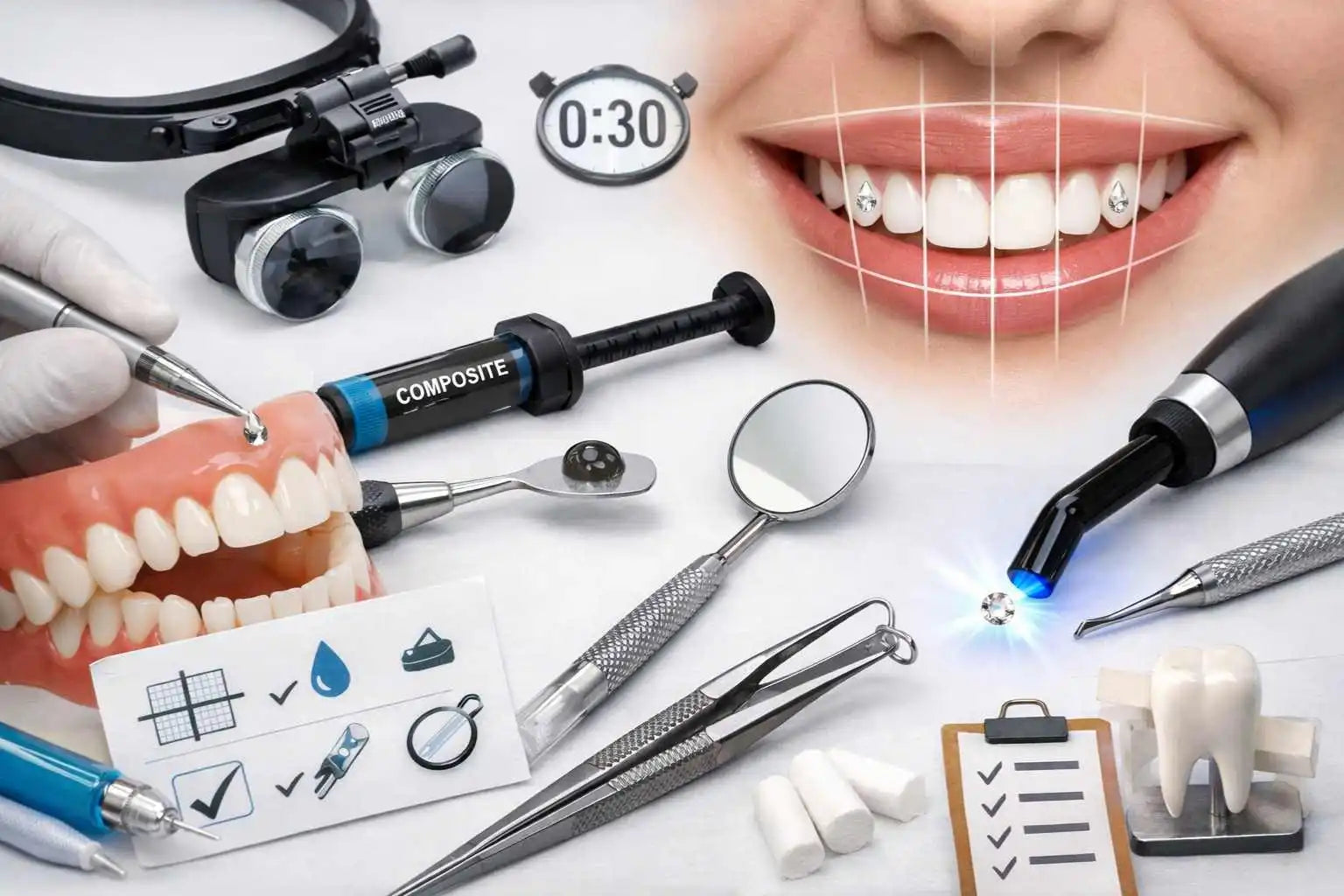
Quick answer: dental systems and para-dental solutions do not always serve the same purpose. For tooth gems, the goal is aesthetic: precise placement, a clean result and coherent hold, without improvised glues. The right system depends on practice level, protocol, product viscosity, ease of placement and precautions to follow.
This comparison explains the differences without turning the article into a clinical protocol.
Summary
- Why compare these systems?
- Understanding adhesion on enamel
- Dental systems: technical logic
- Para-dental solutions: aesthetic logic
- Selection criteria for tooth gems
- Common mistakes
- Selection checklist
- FAQ
Why compare these systems?
The word “glue” is often used very broadly. However, dental jewelry application should not be confused with improvised bonding. Products used should be suitable for the dental surface and the intended use.
Comparing product families helps clarify the differences between technical dental use, a controlled aesthetic approach and products that should always be avoided.
Understanding adhesion on enamel
Enamel is a very smooth surface. To obtain proper fixation, an adapted preparation and compatible product are generally needed. Hold depends on the full sequence: surface, humidity, quantity, placement, possible curing and aftercare.
A good result therefore depends not only on the product but on how it is used.
Dental systems: technical logic
Systems from the dental field serve precise technical uses. They can include surface preparation, an adhesive, resin or composite. Their purpose is not always the same as aesthetic dental jewelry application.
These products should be used according to their intended context, instructions and required skills.
Para-dental solutions: aesthetic logic
In the world of dental jewelry, the logic is different: a small element must be placed precisely, visible excess should be avoided and the finish should remain clean.
Products used in this context should allow controlled placement, stable handling and an aesthetic finish. This never justifies using glue not intended for the mouth.
Selection criteria for tooth gems
To choose a system or material, several criteria matter:
- Compatibility: is the product suitable for the dental surface?
- Viscosity: does it allow precise jewel placement?
- Working time: does it allow enough time to adjust placement?
- Finish: does it help limit visible excess?
- Removal: can removal be done without aggressive gestures?
- Practice level: does the product match the level of the person using it?
Common mistakes
- Using nail glue or super glue.
- Choosing a product only for a hold promise.
- Ignoring surface preparation.
- Using a texture that is hard to control.
- Applying too much product around the jewel.
- Ignoring the placement area.
- Confusing technical dental use with aesthetic use.
- Not thinking about jewel removal.
Selection checklist
- The product is compatible with the dental surface.
- The instructions are clear.
- The texture allows precise placement.
- The quantity can be controlled.
- The finish remains clean.
- Removal does not require scraping or force.
- No improvised glue is used.
- Aftercare advice is planned.
Recommended reading
FAQ
Can classic glue be used on teeth?
No. Classic glues, nail glue, super glue or household adhesives should never be used on teeth.
Why is composite sometimes mentioned?
Because some methods use resin or composite-type materials depending on the protocol. These products should be used in their intended context.
Is the strongest product always the best?
No. For dental jewelry, placement, finish, safety and removal matter as much as hold.
Why is viscosity important?
A texture that is too fluid or too thick can make placement less precise. The product should allow clean jewel positioning.
How can poor choices be avoided?
Avoid improvised products, read instructions, choose compatible products and do not neglect hygiene and aftercare.
Conclusion
Choosing an adhesive or material for tooth gems requires caution. The right solution is not the one that only promises the strongest hold, but the one that allows clean placement, compatible use, controlled finish and non-aggressive removal.


Leave a comment
This site is protected by hCaptcha and the hCaptcha Privacy Policy and Terms of Service apply.