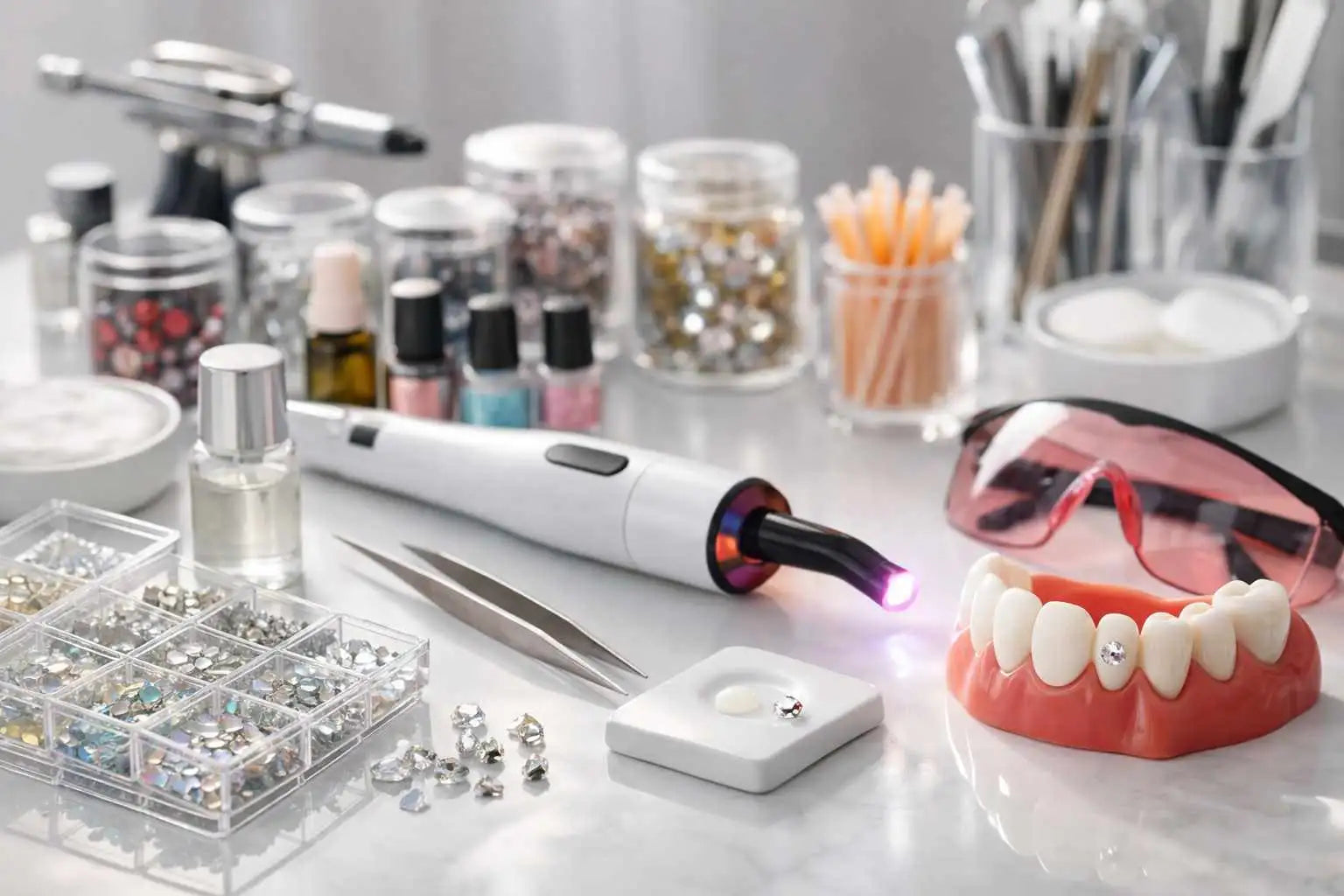
Common mistakes with dental rhinestone application equipment: a complete expert guide to avoid retention failures

Erreurs fréquentes avec le matériel de pose de strass dentaire : guide expert complet pour éviter les échecs de tenue

Quick answer: In most cases, dental gems that come off too quickly don't simply indicate a "bad gem" or a "bad product." They primarily reveal a chain of small errors related to the application equipment and its actual use: a poorly positioned curing light , an insufficiently clean tip, an area contaminated by moisture, improperly stored consumables, inconsistent dosage, or a non-standardized protocol. The problem isn't always visible at the time of application; it only becomes apparent later, when the gems don't last.

In the public imagination, applying dental gems seems like a simple, almost instantaneous process: place them, secure them, and you're done. In practice, however, professionals know that reality is more demanding. A beautiful application isn't just about aesthetics; it's about mastering various variables . Lighting, the dryness of the area, the quality of the technique, the condition of the tools, the consistency of the steps: everything counts. And it's precisely these details, often considered secondary, that create the difference in quality between an application that looks "pretty at first" and one that is truly reliable.

This satellite article adopts a clear and non-cannibalizing SEO intent: it does not replace a product page for purchasing materials, a page dedicated to choosing an adhesive, or a comprehensive training page. It focuses on a specific, useful, and highly sought-after angle in practice: understanding common mistakes with installation materials , correctly diagnosing them, and then establishing preventative habits.

Summary

  • Why installation equipment is often wrongly blamed... or only half rightly so.
  • Mistake #1: believing that a "ready" job is a job that is actually prepared
  • Mistake #2: Underestimating the isolation and dryness of the area
  • Error #3: incorrect use of the curing lamp (distance, angle, stability)
  • Mistake #4: Neglecting the maintenance of the lamp and the tips
  • Error #5: Using consumables that are poorly stored, too old, or poorly managed
  • Mistake #6: Overdosing, underdosing, or varying without realizing it
  • Mistake #7: Using gripping/placement tools unsuitable for the type of rhinestone
  • Mistake #8: Confusing a protocol defect with a product defect
  • Mistake #9: Forgetting quality control before, during, and after installation
  • Mistake #10: Neglecting the logic of hygiene, storage, and maintenance
  • Checklist / tips (safe) for ensuring the reliability of your installation equipment
  • Reading recommendations in the cluster
  • FAQ: Frequently asked questions about dental rhinestones, materials, and application
  • Anti-cannibalization block: main keyword, intention and alternative angle

1) Why installation equipment is often wrongly blamed… or only partially blamed

When a dental jewel comes loose quickly, the most natural reaction is to look for a simple culprit: the gem, the adhesive, the brand, the lamp. This reaction is understandable, but it often leads to a misdiagnosis. In reality, the hold of a dental jewel relies on a complex technical chain. If even one link is unstable, the overall result can fail, even with high-quality materials.

In other words, the equipment can be "at fault" without being "defective." A lamp that works but is used too far from the tooth can produce an unsatisfactory result. A good quality consumable that is improperly stored can become less reliable. A placement tool that is correct but ill-suited to a small rhinestone size can lead to repeated handling, resulting in more contamination and more irregularities. This is why the most meticulous professionals think in terms of systems , not isolated components.

This distinction is crucial for expert e-commerce: good editorial content shouldn't perpetuate the illusion that simply buying "the right product" guarantees a successful installation. Instead, it should help customers understand the equipment's performance requirements, thereby reducing diagnostic errors, unnecessary returns, and customer frustration.

2) Mistake #1: believing that a “ready” position is a position that is actually prepared

The workstation may appear visually ready—lamp on its base, consumables present, tools lined up—without actually being prepared. This is a common, silent, and very costly mistake in terms of quality. The problem stems from the fact that an operational workstation is not simply about the presence of objects; it relies on a logic of active preparation : control, order, accessibility, cleanliness, and verification of critical elements.

In practice, many failures begin even before the first application step: an unchecked lamp, an uninspected nozzle, a consumable left open for too long, a gripping tool replaced at the last minute, or a cluttered workstation forcing an interruption. Each micro-interruption increases the risk of imprecise movements, loss of concentration, and contamination of the work area.

A well-prepared workstation, on the other hand, creates calm. It reduces unnecessary movements. It allows you to stay focused on precision. It facilitates reproducibility, which is the core of professional quality. In editorial SEO, this topic is invaluable because it addresses a frequently implicit question: “Why are my results inconsistent even though I have all the necessary materials?” The answer is often this: having the materials is not the same as knowing how to prepare them .

3) Mistake #2: Underestimating the isolation and dryness of the area

If we had to choose the most frequent, most common, yet most crucial mistake, it would be this: an area that appears dry, but isn't dry enough at the right time. In the world of dental gems , we often talk about the appearance, the size, the shine, and how long they last. We rarely discuss this simple fact: the adhesion is extremely sensitive to contamination, and moisture is often more prevalent than we realize.

The difficulty is that contamination isn't always obvious. It's not necessarily a visible excess of saliva. It could be surface moisture, too long a time between steps, breathing, repositioning that lengthens the sequence, or an area that loses its preparation quality precisely when a stable surface is needed. The result is deceptive: the application may seem correct at first, then fail more quickly than expected.

This error is often misunderstood because it doesn't leave obvious "proof." The professional sees a separation, but doesn't always pinpoint the precise moment the chain was weakened. That's why a serious editorial approach must emphasize that dryness of the area isn't a mere formality, but a fundamental condition for the result. Better insulation not only improves adhesion, but also the precision of the application, confidence during installation, and the ability to correctly diagnose what happened.

Typical warning signs

  • The rhinestone "slips" or repositions itself too easily even though the sequence seems correct.
  • The attire varies greatly from one client to another without any change in equipment.
  • The pose appears visually clear, but the early returns are repeated.
  • The exposure time increases and the area becomes more difficult to stabilize.

4) Error #3: incorrect use of the curing lamp (distance, angle, stability)

The curing light is often treated as a simple "end-of-application button." In reality, it's a central technical element. A lit curing light doesn't automatically guarantee optimal polymerization. What matters isn't just that it works, but how it's used: distance from the tooth, tip angle, hand stability, absence of shadows, adherence to the correct curing time, and consistency of movement.

This is precisely where habit takes precedence over precision. With experience, one can tend to go faster, to "go by feel," assuming that a few millimeters more or less make no difference. However, in practice, these variations can affect the result. A lamp held too far away, an approximate angle, movement during exposure, an unstable position: all these situations can reduce the actual effectiveness of the fixing phase.

The problem is insidious because the error isn't immediately visible. The installation may appear complete, clean, and satisfactory. Only over time do the consequences become apparent: uneven performance, more frequent returns, and unfair suspicion cast upon consumables. This is why expert content must reiterate a simple yet powerful rule: the lamp is not a final accessory; it is a crucial step in the process .

Common mistakes with the lamp

  • Excessive distance between the nozzle and the application area.
  • Poor angle which creates a less even exposure.
  • Unstable hand or movement during the exposure phase.
  • Approximate polymerization time instead of a standardized protocol.
  • Shadows created by position, tool or gesture.

5) Mistake #4: Neglecting the maintenance of the lamp and the tips

Another common pitfall is to assume that "equipment present = equipment performing well." However, a tool can be present, power on, and appear normal, while still operating under degraded conditions. This is particularly true for the curing light and its tip. If the tip is clogged, poorly cleaned, scratched, or simply neglected, a decrease in performance can occur without you even realizing it.

In the daily life of an installation station, maintenance often suffers from a very human bias: it's perceived as a secondary task, especially when business picks up. Priorities take precedence over the next shift, order preparation, customer messages, and general tidying, while the thorough inspection of tools is postponed. Yet, it is precisely this discreet maintenance that protects quality. Well-maintained equipment delivers more consistent results, allows for better diagnosis in case of a problem, and avoids the need to "hunt for an imaginary defect" in consumables.

It's also important to understand that maintenance isn't just about visual cleanliness. It's about consistent professionalism. Cleaning, inspecting, organizing properly, and checking the condition of critical components: these are simple actions that, when combined, transform inconsistent practices into reliable ones. The end customer doesn't always see this rigor, but they experience its effects through perceived quality, consistent results, and confidence in the service.

6) Error #5: Using consumables that are poorly stored, too old, or poorly managed

In many technical fields, storage is underestimated. In dental gem application, this is even more true because the products are small, manageable, easy to move, and sometimes give the impression of remaining "usable" as long as there is some left in the container. Yet, managing consumables is fundamental to quality.

A common mistake is to focus on the remaining quantity rather than the product's reliability: "There's some left, so we'll use it." This reflex is understandable, but it muddles the diagnosis. When results become inconsistent, it becomes difficult to determine whether the problem stems from the technique, the timing, the lamp, or a consumable whose performance is no longer stable. Without minimal traceability or routine verification, clarity is lost.

Poorly planned storage also creates invisible errors: products exposed to heat, left open too long, mixed batches, unclear organization, lack of rotation. And the busier the work environment, the more these errors creep in silently. A premium editorial line must therefore emphasize a simple point: equipment performance isn't just determined during installation; it's also determined in the hours and days leading up to it, when consumables are stored , organized , and managed .

Common management errors

  • Failure to regularly check product dates and rotation.
  • Storing consumables in an unsuitable environment.
  • Mixing batches without minimal monitoring.
  • Opening multiple products in parallel unnecessarily.
  • Continuing to use a product "out of habit" when the results are deteriorating.

7) Mistake #6: Overdosing, underdosing, or varying without realizing it

The application of makeup is a less "spectacular" topic than choosing a rhinestone, a lamp, or an accessory, yet it's one of the most frequent causes of inconsistency. In practice, it's not always a lack of skill that causes the error, but rather a loss of consistency. A faster session, a less stable posture, a tool changed at the last minute, an interrupted movement, a distraction: very little is needed to create a variation in the amount of makeup used from one pose to the next.

The problem with inconsistent dosage is that it completely obscures the diagnosis. When the amount applied changes, the result also changes; but since the variation is often unintentional, there's a tendency to blame something else: the lamp, the product, the tooth, the area, or even "bad luck." In reality, what's most often lacking isn't new equipment, but better standardization of the technique. Professional practice isn't just about achieving beautiful results; it's about achieving reproducible outcomes.

This error is all the more insidious because it can remain invisible for a long time. Not all the applications are unsuccessful; they are simply less consistent. And it is precisely this type of inconsistency that causes fatigue, casts doubt on the protocol, and sometimes leads to changing too many variables at once. A good expert article should therefore emphasize this simple idea: quality depends not only on the “right product,” but on the ability to reproduce a consistent dosage session after session.

Signs of irregular dosing

  • The placement time varies greatly from one pose to another for no apparent reason.
  • The final result sometimes appears sharper, sometimes more "busy", with the same equipment.
  • The stability of the rhinestone during placement is inconsistent.
  • Customer feedback is difficult to attribute to a single cause.

8) Mistake #7: Using gripping/placement tools unsuitable for the type of rhinestone

We often talk about the lamp and consumables, but we very often forget the impact of the tools used for handling and placement. Yet, these are what determine the quality of the most delicate moment: when the rhinestone must be handled cleanly, quickly, and precisely, without dropping it, without unnecessary contamination, and without requiring multiple corrections. A poorly chosen tool doesn't always cause immediate disaster; it first causes a series of small frictions which, accumulated, degrade the overall quality.

A rhinestone that slips once, then a second time; a less-than-perfect shot; an extra repositioning; a hesitation; a slightly less comfortable pose; a sequence that drags on: none of this is particularly striking on its own. But together, these micro-events increase the manipulations, disrupt the fluidity, and make the pose more dependent on chance. This is often how "inexplicable" problems arise: nothing looks overtly wrong, but everything becomes a little less precise.

The choice of tool should therefore be considered a true lever for performance, not an interchangeable detail. The right tool isn't necessarily the most technically advanced or the most "trendy"; it's the one that integrates seamlessly with your technique, your pace, and the type of rhinestone you're working with. The goal isn't just to achieve a single successful application, but to minimize unnecessary steps and establish a stable, repeatable, and clean sequence.

Common mistakes related to placement tools

  • Changing tools too often without standardizing the method.
  • Use a suitable tool, but one not well-suited for small rhinestone sizes.
  • Multiplying repositioning instead of correcting the grip logic.
  • Keeping a worn or inaccurate tool out of habit.

9) Error #8: Confusing a protocol defect with a product defect

This is an extremely common diagnostic error, even among experienced professionals: too quickly attributing a problem to the product when the cause lies in the actual protocol. This confusion is understandable from a human perspective. When a result is disappointing, we look for an identifiable, replaceable, external cause. The product then becomes the prime suspect. But this shortcut is costly because it obscures the real information.

By changing products without first stabilizing the exposure conditions, we often change several variables at once. If the result improves, we attribute this improvement to the new product, when it might actually stem from a better-prepared setup, improved concentration, a smoother sequence, or a lamp used more effectively that day. If the result doesn't improve, we continue searching elsewhere, testing, replacing, accumulating equipment, but we don't address the root cause of the problem.

The best approach is to think like a diagnostic professional: standardize first, observe second, and then modify only one variable at a time. This approach is less dramatic than the knee-jerk reaction of "I'll change everything," but it's incomparably more cost-effective. It allows you to understand what's really happening at the workstation, avoid unnecessary purchases, and build a more mature practice.

Questions to ask yourself before blaming the product

  • Does the problem occur in all poses or only under certain conditions?
  • Were the workstation, lamp, tools and sequence truly standardized?
  • Did the pace, concentration, or exposure time vary?
  • Have the storage and maintenance of the equipment been checked?
  • Were several variables changed at the same time without realizing it?

10) Mistake #9: Forgetting quality control before, during, and after installation

Quality control is often perceived as an "extra" layer, almost an administrative burden. In reality, in the application of dental gems, it's the opposite: simple, streamlined, and repeated quality control saves time. It prevents the same errors from recurring, improves the understanding of their causes, and strengthens the consistency of results. It's not a cumbersome process; it's a management tool.

Quality control doesn't necessarily require a lengthy procedure. It begins with clear reflexes: checking the workstation before the session, observing the stability of the area at the right moment, paying attention to the consistency of the movement, visually validating the final result, and noting any unusual anomalies. These are professional skills. Their value comes from their repetition, not their complexity.

A professional who monitors their work learns faster from their own practice. They distinguish isolated incidents from structural problems. They identify patterns. They improve their results without constantly changing equipment. This approach is what makes the difference between a passive activity (“I don’t understand why it varies”) and a proactive activity (“I know what influences my results”).

Mini quality control routine (safe)

  • Before: check the station, lamp, nozzle, tools, and organization of consumables.
  • During: monitor stability of the area, fluidity of the sequence, gestural consistency.
  • After: visual inspection of the finished product, noting any anomalies, immediate tidying and cleaning.

11) Mistake #10: Neglecting the logic of hygiene, organization, and maintenance of the workstation

Finally, there is a category of errors often treated as "end-of-day details," yet they directly influence the quality of the work: equipment hygiene, workstation organization, and tool maintenance. These elements are not simply about "keeping things tidy." They determine workflow efficiency, precision of movement, and the ability to consistently produce good results.

A cluttered workspace slows things down. It forces you to search for things. It breaks concentration. It multiplies interruptions. A poorly cleaned tool becomes less precise. A neglected end-of-session routine sets the stage for mistakes the next day. Conversely, well-maintained equipment, logically organized and prepared with consistency, creates a calmer, more stable, and more professional work environment. And this calm is reflected in the final result.

In an industry where customer trust rests as much on the result as on the perception of professionalism, the application station itself reveals something about the brand. A rigorous brand isn't recognized solely by its products; it's recognized by how it works, prepares, and maintains its tools. Quality doesn't begin the moment the rhinestone is placed. It begins in the routine that makes that action possible.

Common mistakes : quick summary (5–10 key errors)

  • The position was not properly prepared despite appearing “ready”.
  • Insufficient insulation and area not dry enough at the right time.
  • Lamp misused (distance, angle, stability, time).
  • Lamp/tip poorly maintained and not regularly checked.
  • Consumables that are poorly stored or poorly managed.
  • Irregular dosage (overdose, underdose, unintentional variation).
  • The picking/placement tools are unsuitable for the rhinestone being worked on.
  • Confusion between protocol defect and product defect .
  • Lack of structured quality control .
  • Hygiene/organization/maintenance relegated to the background.

Checklist / tips (safe) for ensuring the reliability of installation equipment

Important: This checklist is a framework for organization, prevention, and quality control. It does not replace practical training, manufacturer's instructions, or locally applicable regulations. Its purpose is to reduce common errors, not to guarantee identical results in all situations.

Before the session: prepare the workstation methodically

  • Visually inspect the curing lamp and its nozzle.
  • Check the overall condition of the gripping and placement tools.
  • Prepare a clean, tidy and legible workstation to avoid interruptions.
  • Check the organization of consumables (rotation, storage, visual condition).
  • Standardize your work set to maintain a stable routine.

During the break: protect the regularity of the protocol

  • Maintain a clean and dry zone as much as possible.
  • Limit unnecessary handling of rhinestones and tools.
  • Maintain a consistent movement with the lamp (distance/angle/stability).
  • Avoid compensating for a mistake with chain improvisation.
  • If a step deteriorates, start again properly instead of speeding up.

After the session: transforming the experience into progress

  • Perform a systematic visual quality control check .
  • Note recurring anomalies to improve diagnosis over time.
  • Clean and put away the tools and lamp immediately.
  • Reintegrate the consumables under good storage conditions.
  • Correct the weaknesses observed before the next session.

Recommendations

To extend the reading experience without disrupting the cluster's objectives, here are the most relevant links. Each URL appears only once, in accordance with your rule.

FAQ: Frequently asked questions about dental rhinestones, application, and equipment

1) Why does a dental rhinestone sometimes come off quickly even though the material seems fine?

Because performance depends on a chain of factors, not a single element. The equipment may be good, but misused or integrated into an unstable protocol: humidity, inconsistent movements, poorly positioned lighting, interrupted sequence, insufficient maintenance, etc. It is often the accumulation of small errors that leads to a disappointing result.

2) Is the problem still due to the glue?

No. This is one of the most common misconceptions. Problems with performance are very often related to insulation , the lamp , dosage , workstation preparation , or variability in the protocol. Before changing products, it's more effective to stabilize working conditions.

3) Can a lamp that turns on still be implicated in poor conduct?

Yes. The fact that it lights up does not guarantee optimal use. Distance, angle, hand stability, the condition of the tip, and consistency of exposure time all strongly influence the quality of the fixation phase.

4) How to distinguish a hardware problem from a technical problem?

By standardizing as much as possible: same workstation, same sequence, same tools, same pace, then modifying one variable at a time. If everything changes simultaneously, diagnosis becomes impossible. The goal is to create a stable framework to clearly observe the causes.

5) Why are my results inconsistent from day to day with the same equipment?

Because it's not just the equipment that influences performance. Concentration level, station preparation, interruptions, posture, time spent on each step, and moisture management can all vary from session to session. Irregularity often indicates a need for a more stable protocol.

6) Can gripping and placement accessories really change the quality of an installation?

Yes, especially indirectly but decisively. An unsuitable tool can lead to falls, repositioning, additional handling, and a longer sequence of actions. This increases the risk of errors and reduces the reproducibility of the movement.

7) What questions do customers most often ask about dental rhinestones?

The most frequently asked questions generally concern: wear, comfort, brushing, risks to enamel, removal options, the qualifications of a professional to apply rhinestones, and the consequences of improper application. Effective communication must address these questions with nuance, avoiding excessive promises and clearly distinguishing between product information, usage instructions, and limitations of liability.

8) What is the best way to avoid common mistakes when you want to professionalize your poses?

Establish a simple but consistent discipline: prepared workstation, maintained equipment, appropriate tools, standardized sequence, quality control, and progressive improvement. Professionalization relies less on the accumulation of equipment than on the ability to work consistently , cleanly , and in a traceable manner.

Conclusion

Over time, the best professionals all reach the same conclusion: the quality of an installation doesn't depend on a single "good product," but on a collection of meticulously executed details. Installation equipment isn't just decoration. It's a chain of tools, routines, and techniques that must work together seamlessly. When this chain is carefully planned, maintained, and standardized, results become more consistent, diagnoses more accurate, and trust—for both the professional and the client—becomes stronger.

In other words, moving upmarket doesn't always start with buying more. It often starts with better preparing , better using , and better controlling what you already have.

Leave a comment

This site is protected by hCaptcha and the hCaptcha Privacy Policy and Terms of Service apply.

Reading next

Workflow professionnel : gagner du temps sans perdre en qualité