Dental jewelry: the complete guide to understanding, choosing and caring for your tooth gems
Tooth gems (sometimes called dental rhinestones ) have become a beauty accessory in their own right: they allow you to personalize your smile with a touch of sparkle, from discreet crystals to bolder Swarovski shapes. But between prices , DIY kits , adhesives , application , removal , and safety concerns, it can be difficult to know where to start. This guide aims to centralize all the essential information, with a simple approach: to help you make informed decisions, safely and securely.
What exactly is a dental jewel?
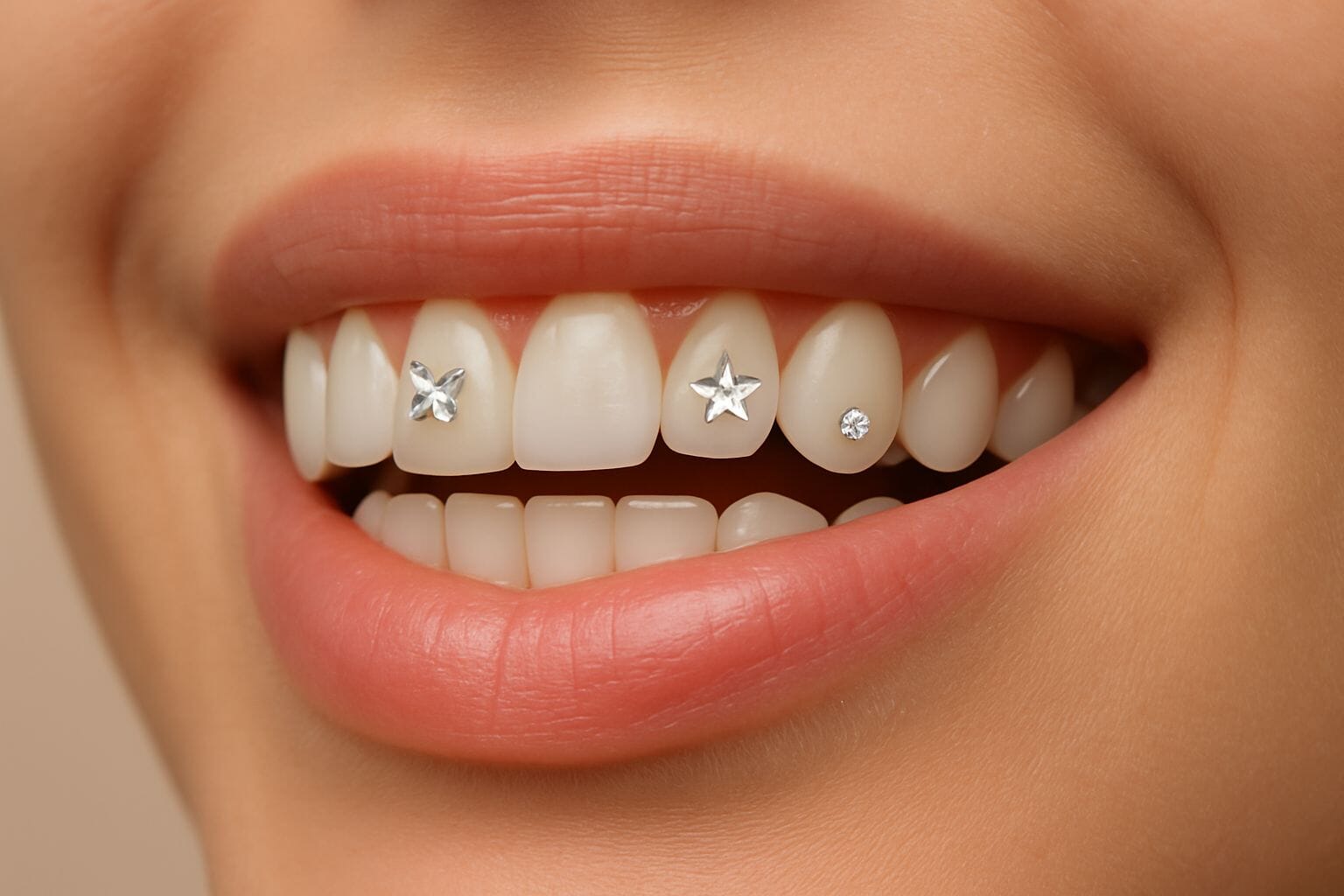
A dental jewel is a small ornament, often made of crystal, high-quality glass, or precious metal, temporarily bonded to the surface of the tooth. It involves neither drilling nor screws, but it is still a procedure that affects the enamel and should therefore be taken seriously.
- Crystal tooth gems : transparent or colored crystals for a “diamond” effect.
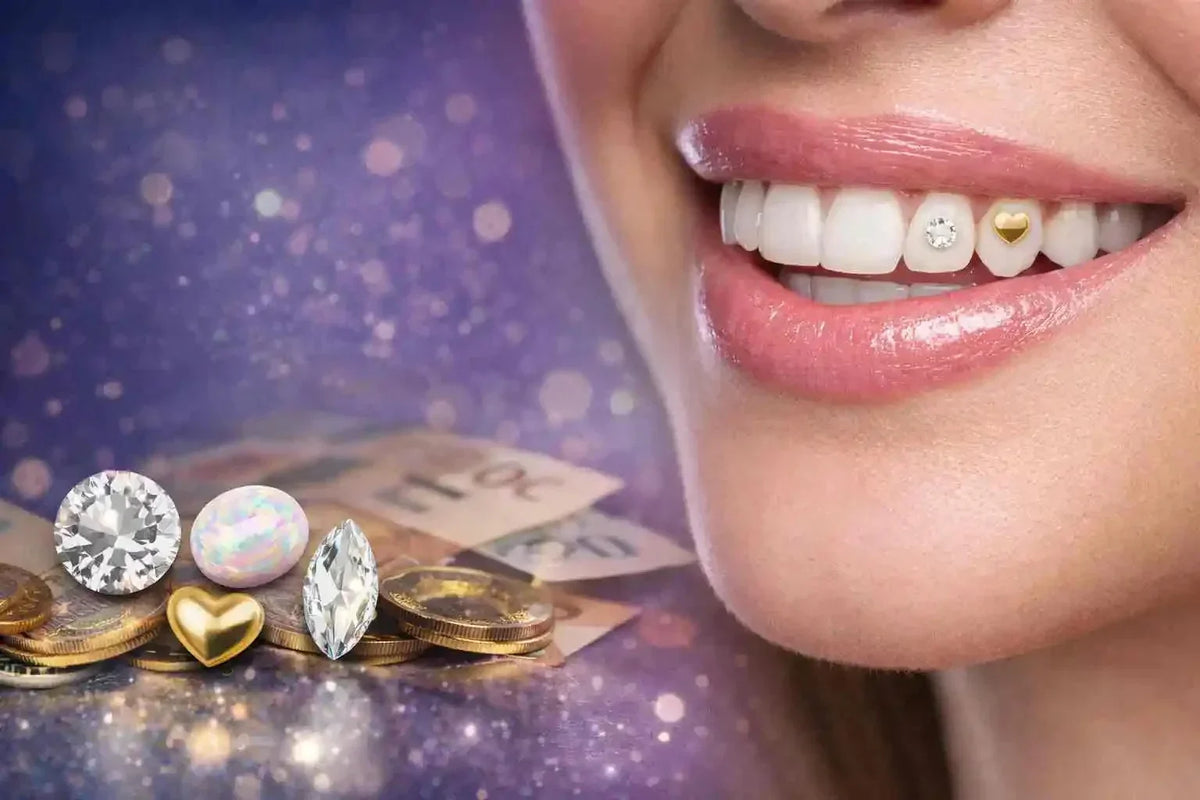
- Gold dental jewelry : small gold motifs (yellow, white, sometimes rose) for a more “jewelry-like” look.
- Opal dental jewelry: dental rhinestones in various shapes with crazy colors.
- Swarovski/Preciosa dental jewel : crystals cut for maximum brilliance.
- Creative shapes : heart, star, butterfly, shuttle, diamond… for more personalized designs.
The purpose of this guide is not to encourage you to do everything yourself, but to explain what is reasonable, what is risky, and what options exist (installation in a salon, by a trained professional, or with suitable DIY kits ).
Dental jewelry: types, styles and materials available
There are many ways to wear tooth jewelry , from a discreet detail to a very visible design. The choice depends on your style, your environment (professional, personal), and your tolerance for bold looks.
- Minimalist look : a single crystal on a canine or incisor tooth.
- Signature look : a distinctive shape (heart, butterfly, star…).
- Constellation look : several pieces of jewelry aligned or in a pattern.
- Jewelry look : gold motifs or metal + crystal combinations.
High-quality materials (high-end crystal, specific glass, gold) are preferable to plastics or poor-quality imitations, for reasons of appearance but also comfort and durability.
Gold, crystal, Swarovski, Preciosa dental jewelry: how to choose?
The choice of material has an impact on the appearance, the perception of "luxury" and sometimes on the budget.
- Gold dental jewelry : perfect if you want a premium look, visually lasting, often more discreet but very chic.
- Swarovski/Preciosa tooth gem : ideal if you want a strong sparkle, visible in photos and videos.
- Clear crystal : versatile “diamond” effect, which adapts to all styles.
- Colors : blue, pink, AB, etc. for more fun or bold looks.
I've been talking to you about Swarovski and Preciosa for a while now, but what do they mean?
Preciosa is a brand as renowned as Swarovski in the world of dental rhinestones, both for its quality and its brilliance.
The quality is impeccable; I would even go so far as to say that the Preciosa rhinestones are brighter.
But the right question is not “which is the best?”, but rather “which style matches my personality and my daily life?” .
Price of a dental rhinestone: understanding the true cost of a dental jewel
The price of a dental jewel depends on several factors: material, method of application, geographical location, reputation of the professional and any associated care (cleaning, check-up, etc.).
- Installation at a salon or practitioner's office : price often "all inclusive" (jewelry + installation).
- Installation with a kit : cost of the kit + possibly the dental jewel purchased separately.
- Number of pieces of jewelry : the more you wear, the higher the total budget.
The aim of this guide is to help you assess whether the price offered is consistent with the service, and to help you avoid dubious offers or offers that are too good to be true.
For a detailed comparison, you can refer to our detailed article on the price of dental jewelry .
Dental rhinestone kits and dental jewelry kits: what are the differences?
Not all dental jewelry kits are created equal. Some are designed for trained professionals, others for individuals, with clear limitations in terms of safety and results.
- Professional-oriented kits : designed for trained individuals, with more technical products.
- Beginner-oriented kits : for doing your own poses with all the materials and instructions provided.
- Incomplete kits : require the separate purchase of certain items (jewelry, consumables, etc.).
Before choosing a kit, it is essential to check who it is designed for and what it can actually do, without exceeding reasonable safety limits.
To learn more, you can read our guide to choosing the right dental jewelry kit .
Dental rhinestone glue: why you shouldn't improvise
Adhesive is a critical element. Using an unsuitable adhesive (false nail glue, super glue, etc.) on a tooth or gum can be dangerous for the enamel, tissues and oral health.
- Never use glues not intended for use in the mouth .
- Respect the protocols of professionals and the limits of what can be done at home.
- If in doubt, seek the advice of a dentist or trained professional.
A dedicated article will answer in more detail the question which glue to use (or not to use) for a dental jewel?, with a focus on safety and limits not to be exceeded.
Applying and removing a dental rhinestone: what you absolutely need to know
The placement and removal of jewelry on a tooth should never be taken lightly. The procedure involves the enamel, which does not regenerate. Improper technique can lead to roughness, sensitivity, and even promote plaque retention.
- Opt for installation by a trained professional or under strict supervision.
- Absolutely avoid aggressive techniques for removing jewelry yourself.
- If you experience discomfort, pain or have any doubts, consult a dentist .
Two more detailed resources might help you: how a dental jewelry application is performed and how to remove a dental jewel without damaging the enamel .
History of dental jewelry: from ancient civilizations to modern trends
Dental jewelry is not a recent invention of social media. The idea of decorating teeth dates back several centuries, or even several millennia, in different cultures around the world.
- Ancient civilizations : in some pre-Columbian cultures, ornaments inlaid in teeth (stones, patterns) were already found as a symbol of status, courage or belonging to an elite.
- Jewelry influence : over time, body ornamentation (piercings, jewelry, tattoos) has expanded, and the tooth has gradually become a medium like any other to express one's identity.
- Pop culture and music : from the end of the 20th century, the aesthetics of “grillz” and decorated teeth appeared in certain musical currents (rap, R&B, urban culture), with a very strong dimension of success, self-affirmation and staging.
- 2000s–2010s : the first crystals glued onto the tooth became a trend in fashion and aesthetics, often in salons or institutes, with more discreet and feminine looks.
- Current era : the rise of social media, selfies, and beauty content has caused tooth gems to explode in visibility. Dental jewelry is now halfway between a fashion accessory, a form of personal expression, and an aesthetic signature, with styles ranging from minimalist to highly elaborate.
This evolution explains why dental jewelry is now found in such diverse settings: beauty salons, offices of trained professionals, specialized designers, and online platforms. The modern challenge is no longer simply to embrace the look, but to do so with reliable materials and an approach that respects oral health .
To discover this evolution in more detail, you can read our full article on the history of dental jewelry .
The perception of dental jewelry around the world
The way dental jewelry is perceived varies greatly from country to country. In some places, it is seen as a simple trendy accessory, in others as a strong social marker, and elsewhere as something very marginal.
- In Europe : dental jewelry is often associated with fashion, aesthetics, and social media. It is seen as a beauty accessory, just like a piercing or sophisticated nail art.
- In North America : it is sometimes linked to certain cultural scenes (music, streetwear, urban culture), but also to a search for uniqueness and visual “signature”.
- In Latin America and in some ancient cultures : the idea of decorating teeth is not new and is sometimes part of a historical continuity of symbols of status, strength or belonging.
- In some countries : tooth jewelry is still perceived as something very atypical, or even misunderstood, which can influence how it is worn (more discreet, reserved for certain contexts).
If you want to delve deeper into these cultural differences and understand how dental jewelry is viewed in different countries and social codes, you can read our article dedicated to the perception of dental jewelry around the world .
Psychological impact of a dental jewel: self-confidence, image and identity
Beyond aesthetics, dental jewelry can also impact self-confidence and self-perception. For some, it's simply a fun detail. For others, it's a true tool for expressing their identity.
- Feeling more “yourself” : choosing a specific piece of jewelry (shape, color, style) can give the impression of aligning your appearance with your personality, and therefore boosting self-esteem.
- Embracing one's image : wearing jewelry on the teeth, especially if it is visible, can help to be more confident in one's smile, photos, presence on social networks or in daily life.
- “Ritual” effect : for some people, the placement of a dental jewel marks a change (new stage, new style, important moment), a bit like a new haircut or a symbolic tattoo.
- Let's be realistic : while the impact can be positive, jewelry is no substitute for deeper work on self-confidence. It's an added bonus, not a magic bullet.
We develop these aspects in more detail in our article on the psychological impact of dental jewelry and self-confidence , with some ideas for wearing this type of accessory in a way that aligns with your well-being.
Tooth jewelry trends for 2025: styles, shapes, and inspirations
Dental jewelry also follows trends. Some years emphasize shapes, others colors or more complex compositions.
- Key shapes : heart, star, butterfly, shuttle, diamond.
- “Luxury” looks : gold + crystal, combinations of several pieces of jewelry.
- Minimalist looks : a single clear crystal, very discreet.
For concrete ideas on placement and design, you can consult our article on dental jewelry trends and placement ideas. .
Risks, precautions and oral health
A dental jewel is, first and foremost, an object placed in the mouth. It can slightly alter the way you brush your teeth, or trap a little more plaque if it's not properly cared for.
- Monitor for the appearance of spots or sensitivity around the area.
- Reinforce oral hygiene (thorough brushing, floss/interdental brushes if advised).
- Do not ignore the slightest discomfort and consult a doctor if in doubt.
To go into more detail, you can read our full article on the risks, precautions and hygiene with a dental jewel .
Dental jewelry and whitening: in what order?
Many people want teeth whitening and a dental jewel . The order is important: generally, you start by stabilizing the color of the teeth (whitening, if indicated and outlined), then you add the jewel.
The idea is to avoid having a piece of jewelry that does not adapt to the changing color and to avoid complicating subsequent care.
To go into more detail, you can read our full article on teeth whitening and dental rhinestone application .
Where can I get a dental jewel fitted?
The question “ where to get a dental jewel placed? ” comes up very frequently. Depending on the country, regulations can be strict or more lenient. In any case, it is best to go to:
- A professional specifically trained in the application of dental jewelry.
- A clean environment , with a serious hygiene protocol.
- A person who clearly explains what is done, and what should not be done.
You can find a list of criteria to check in our guide to choosing where to get a dental jewel fitted .
Common mistakes with dental jewelry
Some mistakes are common and can turn a good idea into a source of stress. Here are a few to absolutely avoid.
- Using an unsuitable glue (strong glue, false nail glue, etc.).
- Try scraping the jewelry with a hard or metallic object.
- Ignoring signs of pain or discomfort.
- Wearing multiple pieces of jewelry without considering occlusion and friction.
- Do not adapt your brushing technique around the area.
For a detailed and illustrated list, you can consult our article on common mistakes with dental jewelry .
Training in the application and removal of dental jewelry
The application and removal of dental jewelry (tooth gems) is not something to be taken lightly. Beyond aesthetics, it involves working on the enamel in a sensitive environment (the mouth), requiring strict hygiene protocols and precise techniques.
This is why the application of dental rhinestones and jewelry should be performed by trained professionals who understand both:
- the essential steps before installation (preparation, information, hygiene),
- the limits that must not be exceeded to respect oral health ,
- Good removal practices to preserve the enamel as much as possible.
At Tooth Gems World, we offer training courses dedicated to the application and removal of dental jewelry for those who wish to become professionals or add this service to their business (institutes, salons, independent professionals, etc.).
To discover the content of the modules, the prerequisites and the support offered, you can consult our dental jewelry training page .
Discover Tooth Gems World dental jewelry
If you wish to discover quality dental jewelry designs, you can explore the dedicated collections of Tooth Gems World.
- Collection of “classic” dental rhinestones (round crystals for a timeless look).
- Collection of Swarovski shaped dental rhinestones (heart, star, butterfly, shuttle, diamond…).
- Collection of dental jewelry application kits (DIY) (kits adapted to different skill levels).
- Installation equipment collection (tools and consumables suitable for trained professionals).
- Gold dental jewelry collection (gold motifs for a jewelry-like finish).
- Opal jewelry collection (original design)
- Accessories Collection .
- Starter Pack Collection (all the necessary dental equipment and jewelry in one product)
- Our training courses on dental jewelry
- Our assortments of dental rhinestones
These collection pages are accompanied by explanatory texts (mini-guides) to help you choose according to your style and level.
Articles to explore
This comprehensive guide is complemented by more targeted articles that answer specific questions. They delve deeper into certain key themes related to dental jewelry .
Why Tooth Gems World for your dental jewelry?
Tooth Gems World positions itself as a European benchmark in dental jewelry , with a strong focus on quality and support.
- Specialization : a catalogue dedicated to tooth gems, kits and application materials.
- Quality selection : crystals, shapes and materials chosen for their appearance and reliability.
- Transparency : clear information on the limits, precautions and importance of the role of professionals.
- Support : educational content (guides, articles) to help you make informed choices.
- Long-term vision : an approach focused on respecting oral health and enamel.
Dental Jewelry FAQ
Dental jewelry: how much does it cost on average?
The price varies depending on the material, the placement location, and the type of service (placement only, jewelry included, follow-up, etc.). Our article on the price of dental jewelry details the price ranges and factors to consider.
Where can I get a dental jewel fitted?
It is recommended to consult a trained professional in a clean environment, with a clear explanation of the procedure. You will find concrete guidelines in our guide to choosing the right place to get your dental jewelry done .
What type of glue is used for dental jewelry?
Adhesives not intended for oral use (super glue, false nail glue, etc.) should be avoided. We discuss this point in detail in our article on dental jewelry adhesive , with a focus on safety.
How to apply a dental jewel?
The application must follow precise protocols to minimize the impact on the enamel and avoid complications. Our guide to applying dental jewelry explains what is reasonable to do and what should remain the domain of a professional.
How do I remove a dental jewel?
It is not recommended to scrape or remove jewelry from a tooth yourself. Removal should be done by a trained professional to protect the enamel. You can read our article on removing dental jewelry for more information.
How long does a dental jewel last?
The durability depends on the type of jewelry, the adhesive used, the application technique, and lifestyle factors (diet, bruxism, etc.). Our content on the durability and lifespan of dental jewelry details these parameters.
Can you whiten a tooth with a dental jewel?
Generally, whitening is preferred first (when indicated and properly supervised), followed by the application of a dental jewel. Our article “Dental Jewels and Whitening” answers this question in detail.
Does dental jewelry damage teeth?
Properly handled, correctly applied, and carefully removed jewelry minimizes risks. Improper use (incorrect adhesive, scratching, poor hygiene) can lead to problems. Our guide on risks, precautions, and hygiene details these points to consider.
In conclusion: how to use this guide on dental jewelry?
This guide is intended to be your central resource on the subject of dental jewelry . You can use it to:
- Understand the basics before making a decision.
- Explore the collections best suited to your style using the “Shop / Collections” block.
- Explore a specific topic further with supplementary articles (price, glue, installation, risks, trends, etc.).
- Identify what should remain the domain of a trained professional or dentist .
It's up to you to navigate between the sections and the additional guides to build a clear vision, aligned with both your style and the confidence of your smile .


Leave a comment
This site is protected by hCaptcha and the hCaptcha Privacy Policy and Terms of Service apply.