
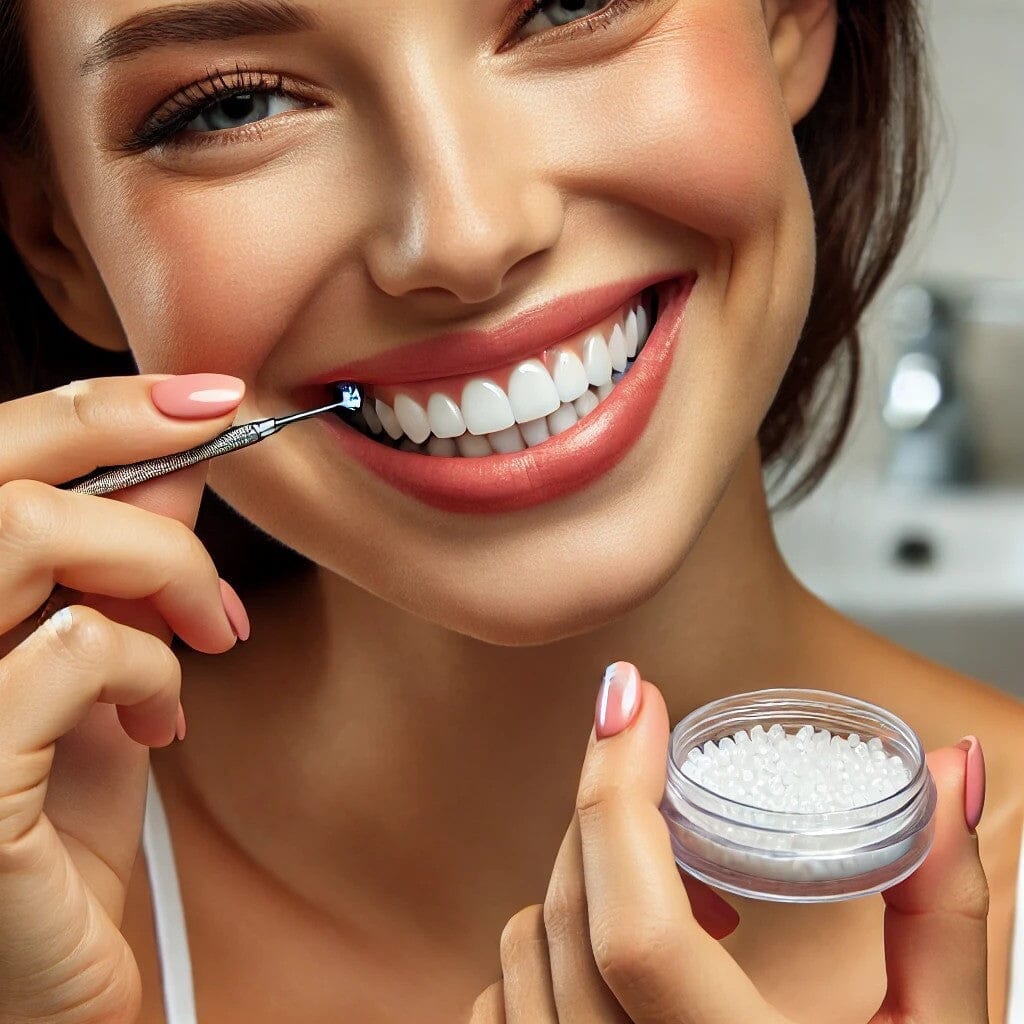
Quick answer: a DIY tooth-gem kit does not automatically make placement suitable or risk-free. The American Dental Association advises against cosmetic tooth gems because of potential adverse effects, and the Oral Health Foundation recommends speaking to a dentist first so teeth and gums can be checked.
Never use nail glue, super glue or household adhesive on a tooth. Do not pull or scrape a gem off to remove it.
What a kit can — and cannot — prove
A kit packages several items together. By itself, it does not prove:
- that every product is intended for the proposed use;
- that the components are compatible with one another;
- that the curing light meets the system’s requirements;
- that the intended user is the general public;
- that the condition of the tooth is suitable for a gem;
- that the activity is permitted in the same way in every country;
- that removal can be completed without damage.
A “beginner” label or short video does not replace instructions, traceability and dental advice.
Before any decision: arrange a dental check
Only a dentist can properly examine and diagnose the condition of a tooth and gums. Postpone any attempt and seek advice if there is pain, unexplained sensitivity, red or swollen gums, bleeding, a lesion, an apparent crack, suspected decay, orthodontic appliances or recent dental treatment.
The absence of pain does not prove that a tooth is healthy. Use the pre-placement checklist to organise the questions that need to be checked.
Products that must be excluded
- nail glue;
- consumer cyanoacrylate or super glue;
- craft, repair or household adhesive;
- decanted product without a label;
- a product with an unknown manufacturer or intended purpose;
- expired product or product stored outside stated conditions;
- a mix of components without written compatibility.
A product sticking or resisting moisture does not establish that it is intended for enamel, the mouth or this use. Read the bonding-system comparison.
Check a kit without relying on claims
| Check | Expected information |
|---|---|
| Identity | Exact name of every product and an identifiable manufacturer |
| Intended purpose | Clearly written use and intended users |
| Instructions | Complete, understandable and consistent directions |
| Compatibility | Components and curing light explicitly associated |
| Traceability | Batch, date, original packaging and proof of purchase |
| Storage | Temperature, light and shelf life stated |
| Safety | Warnings and actions to take available |
| Removal | Clear limits and referral to a dentist |
If essential information is missing, do not fill the gap with an assumption or social media advice.
A decision pathway, not a home tutorial
- Understand the risks and seek dental advice.
- Check local rules and the intended user for the products.
- Read every set of instructions before buying or opening the kit.
- Check each product, batch, date, storage conditions and compatibility.
- Plan aftercare, warning signs and a dentist-led removal route.
- Do not proceed if the tooth’s condition, the applicable requirements or the documents are unclear.
This page deliberately does not provide a home-application protocol. A sequence of online steps cannot examine a tooth, validate products or manage a complication.
If a gem is already in place
Maintain regular oral hygiene and carefully clean around the gem rather than avoiding the area. Do not play with it, test it with the tongue or bite directly onto it. Read the aftercare guide.
If the gem moves or falls off
Do not pull it, reattach it or scrape residue. Limit handling and seek dental advice, especially if the surface feels rough, sensitive or painful.
Signs that require prompt advice
Pain, persistent sensitivity, swelling, bleeding, irritated gums, a change to the tooth, difficulty cleaning or unusual discharge justify professional advice.
Removal is not a DIY step
Do not use solvent, acetone, a metal tool or force to remove a gem. Pulling or scraping can damage the tooth surface or leave residue that is difficult to assess.
The prudent option is to ask a dentist to examine the tooth and perform or arrange removal. Read the removal guide.
Minors, consent and local rules
Rules for minors, consent and permitted activities vary by country. Parental consent, where applicable, does not turn a prohibited act into a permitted one and does not replace a dental assessment.
Check national and local authorities, insurance and the products’ intended use. The regulatory guide explains the method without replacing legal advice.
Frequently asked questions
Is a DIY kit suitable because it includes a light?
No. The presence of a light does not establish compatibility with the products or suitability of the kit for the intended use.
Can nail glue be used just once?
No. Adhesive intended for nails or repairs is not designed for application to a tooth.
Is a video enough to learn?
No. A video cannot replace instructions, examination of the tooth, legal checks or the ability to manage an incident.
What if the gem does not stay in place?
Do not automatically try again. Have the tooth, context and any residue checked, then reassess the products and instructions.
Can a loose gem be removed at home?
Do not pull or scrape it. Seek dental advice.
Related reading
Sources and limitations
- American Dental Association: Oral Piercing/Jewelry
- American Academy of Pediatric Dentistry: oral jewellery policy
- Oral Health Foundation: Tooth gems and grillz
- EUR-Lex: Regulation (EU) 2023/988 on general product safety
Sources checked on 4 September 2026. General information only: it does not replace dental examination, diagnosis or care, or legal advice about the rules in your country.
Questions about a product or an order?
The Tooth Gems World team can help you check a product’s specifications, understand what a kit includes or locate an order. For health or treatment advice, speak to a dentist.
- Contact customer service through the form or live chat.
- Check delivery rates and estimated times and our payment methods.
- After ordering, find your purchases in your customer account or visit our Help Centre.

Leave a comment
This site is protected by hCaptcha and the hCaptcha Privacy Policy and Terms of Service apply.