
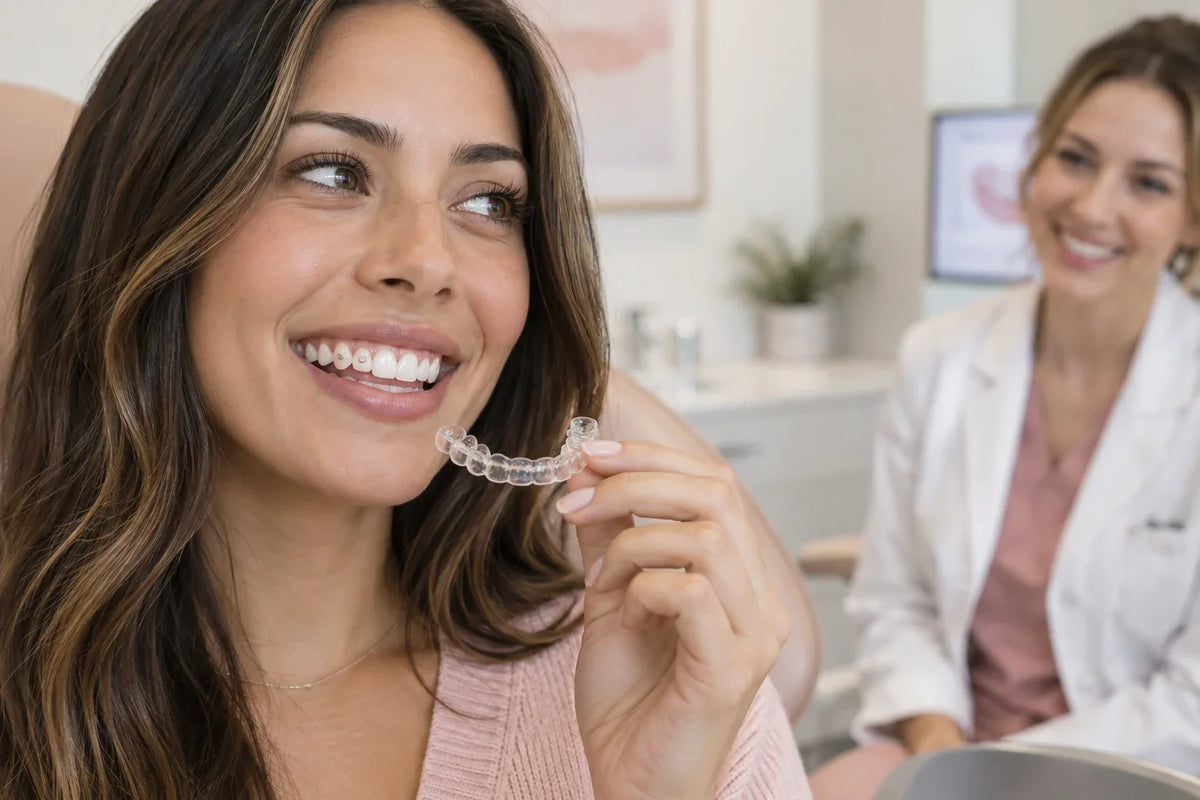
Can you wear a tooth gem during orthodontic treatment? It depends on the appliance, but the safest rule is simple: ask for your orthodontist’s approval first and, in most cases, wait until treatment is complete. A gem bonded to the tooth can make cleaning around fixed braces harder or change the precise fit of an aligner or retainer.
This guide provides general information. It does not replace an examination or instructions from your dentist or orthodontist.
Why can a tooth gem interfere with orthodontic treatment?
A tooth gem adds a small raised area to the front of a tooth. Orthodontic treatment relies on controlled forces and closely fitted appliances. Brackets, wires, attachments and trays need to work without obstruction and remain easy to clean.
The FDA explains that clear aligners are prescribed devices that require professional supervision. Changing the tooth surface or the appliance yourself can therefore interfere with an individual treatment plan.
Tooth gems with fixed braces
With fixed braces, part of the tooth surface is already occupied by the bracket and wire. Adding a gem may:
- create another area where plaque can collect;
- make brushing around the bracket and gem more difficult;
- interfere with changing a wire, elastic or accessory;
- need to be removed when the braces come off and the teeth are polished.
This is not a universal ban, but a clinical decision. Only the orthodontist who knows your treatment plan can confirm whether a specific position is compatible. Never bond a gem to a bracket, wire or orthodontic elastic.
Tooth gems with clear aligners
An aligner is made to follow the exact shape of the teeth and any attachments. A tooth gem added after the tray was made changes that shape. The aligner may stop seating fully, apply unexpected pressure or leave a visible gap.
Never cut, heat or file an aligner yourself. Do not attach a gem to the tray either. A loose piece could be swallowed or inhaled, and adhesive not intended for this purpose should not remain in the mouth.
If you already have a gem before an orthodontic scan, mention it. Your orthodontist will decide whether it should be removed before the digital impression or whether the timing can be adapted.
What about retainers?
A retainer keeps teeth stable after treatment. A removable night-time retainer still fits closely over the teeth, so a new raised surface can prevent it from seating completely. A new dental impression may sometimes be needed, but that decision belongs to the clinician. A fixed wire behind the teeth creates a different mechanical situation, yet enamel health and cleaning still matter.
Checklist before you decide
- Obtain your orthodontist’s approval before any application.
- Make sure the tooth is healthy. Decay, cracks, persistent sensitivity, gum inflammation or demineralisation need dental assessment.
- Show the exact position you want. A tooth not involved at present may need an attachment or further movement later.
- Prefer professional application. Never use household glue or a kit whose contents or application protocol are not clearly identified.
- Improve daily cleaning. Brush carefully around the braces and gem, following your dental team’s advice.
- Plan safe removal. If the clinician asks for removal, do not scrape or pull the gem off yourself.
For general precautions, also read our guide to tooth gem hygiene and safety.
If the aligner or retainer no longer fits
Do not force or alter it. Only remove it as instructed and contact your orthodontist promptly. Tell them when the gem was applied, which tooth is involved and when the fit changed. A tray that does not seat correctly may not deliver the intended forces.
Seek professional advice promptly for unusual pain, swelling, persistent bleeding, a loose gem, cheek injury or suspected swallowing or inhalation. Breathing difficulty requires urgent medical help.
When is the best time for a tooth gem?
For many people, the simplest time is after active orthodontic treatment, once the orthodontist has approved stability and retention. This makes it easier to choose a position without interfering with planned tooth movement. Remember that removing braces does not end follow-up care: compatibility with your retainer still needs to be checked.
Once you have professional approval, browse our tooth gem collection. Professionals who want to strengthen their protocol can also review our tooth gem training covering equipment selection, application, hygiene and removal.
FAQ
Can a tooth gem be placed on a bracket?
No. A bracket is an active part of the appliance. Covering it or adding jewellery can interfere with treatment and cleaning.
Can I cut an aligner around a tooth gem?
Not unless the change is made or expressly prescribed by your orthodontist. A DIY cut can spoil the fit, create an irritating edge and alter the forces applied.
Can a future aligner be designed around a gem?
Only the orthodontist can answer after an examination. They may request removal before scanning or adapt the timing. Do not assume the software will automatically compensate for the raised surface.
Should a gem be removed before braces come off?
It depends on its position and the clinic’s protocol. Ask at the appointment before debonding so professional removal can be arranged if needed.
Can a gem be placed on a weakened tooth?
A tooth with decay, a crack, hypersensitivity, demineralisation or a restoration requires a dentist’s advice. An online article cannot confirm that a tooth is suitable.
Key takeaway
Braces, aligners and retainers each have different constraints. Orthodontist approval, a healthy tooth, a compatible position and a professional protocol are essential. When in doubt, waiting until treatment is finished is usually the simplest and most cautious option.


Leave a comment
This site is protected by hCaptcha and the hCaptcha Privacy Policy and Terms of Service apply.