
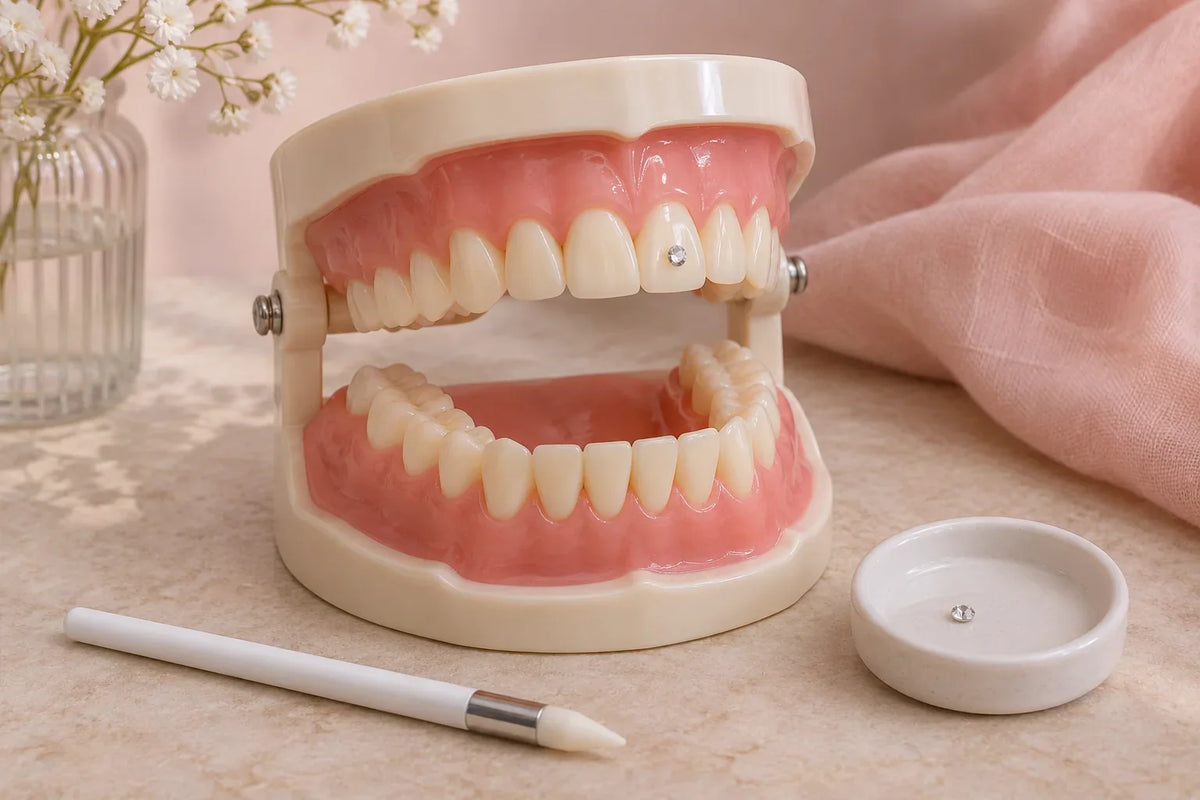
A gem that turns as you set it down, or a pair whose spacing changes with every attempt: these are two things you can work on with a dental practice model. Start dry, without bonding products, so you can observe your movements before trying to work faster.
The following three exercises focus on handling and visual positioning. They are not a protocol for applying gems in the mouth and do not establish clinical competence or validate how well a gem will stay on a natural tooth.
Prepare a small selection that is easy to compare
Set the dental practice model on a stable surface under consistent lighting. Keep a small dish for the gems used during the session and separate them from the stock intended for client appointments.
To begin, choose one product in two sizes. The Preciosa Crystal product page lists SS3 as 1.4 mm and SS5 as 1.8 mm, with approximately 60 pieces per pack: two practical reference points for comparing proportions without introducing multiple colours.
A single-use wax-tipped applicator is used to pick up small pieces. Keep the one used during the session for practice, then discard it after use; do not use it for a client appointment.
Three dry exercises to observe your progress
1. Pick up and set down a gem without dropping it
Place a gem in the dish, pick it up with the applicator and set it down at your chosen point on an accessible artificial tooth. Without bonding, it may slide: focus on the movement and your control as you set it down, without trying to make it stay.
Repeat several times with the same size. Note any drops, extra attempts and moments when you lose sight of the tip; adjust just one thing at a time, such as how you support your hand or the angle of the model.
2. Return to the same position
Choose a visual reference point on the artificial tooth and try to return to it with each placement. Photograph your attempts from the same angle to compare the centring, rather than relying solely on memory.
Then work on another tooth on the model. The aim is to see how your working position changes, without treating a successful position on the model as a recommendation for a client's mouth.
3. Compare a single gem with a pair
First compare SS3 and SS5 individually, then consider a pair. If the gems will not stay in position when dry, study their spacing in the dish beside the model, without improvising an adhesive for this exercise.
Look at the arrangement from the front and at a three-quarter angle. Note which size draws the eye and whether the second gem remains distinct; these observations will help you explain design options to your clients, without promising an identical result in the mouth.
Keep a useful record of each session
A photo and a few notes are enough to make the comparison useful. Repeat the same exercise during another session before adding new shapes.
- Record the product and size used, along with the artificial tooth you chose.
- Note the difficulties you observed: dropping, orientation, visibility or inconsistent placement.
- Choose one specific point to work on in your next session.
Avoid judging progress by the stopwatch alone. A quick placement that needs several further attempts tells you something different from a movement whose variations you understand.
What a practice model cannot validate
A model does not reproduce all the conditions of a real mouth and cannot replace a dental examination. The way a gem behaves on its surface cannot predict its adhesion to enamel, how long it will stay in place or its safety.
These exercises require no etching gel, primer, composite or curing light. For any technical practice involving products, follow the instructions and seek suitable guidance; do not transfer a test on an artificial surface to a person.
The American Dental Association advises against cosmetic tooth gems because of the risks to oral health. Before applying gems in the mouth, seek a dentist's advice; pain, sensitivity or irritated gums call for an assessment, not a placement trial.
Frequently asked questions
Do you need lots of gems to practise?
No. One product in two sizes is enough to start comparing handling and proportions. Expand your selection once you know exactly what you want to work on.
Will a gem that stays on the model stay in the mouth?
You cannot draw that conclusion from this test. The artificial surface validates neither the bonding system on a natural tooth nor its safety.
Does a practice model replace training?
No. It provides a surface for repetition; hygiene, the limits of practice and assessing a real situation require separate learning. Check the content of our tooth gem application courses to choose suitable guidance.
Prepare your next session
Start with a specific difficulty and a small selection. Use the model and accessory links in this guide to fill gaps in your equipment; if you are building your setup, our guide to getting started without overbuying will help you plan your order.
Sources and scope of this guidance
Dimensions and pack quantities come from the Tooth Gems World product pages linked in this article, consulted on 17 November 2026. The exercises are editorial suggestions for dry handling practice, without clinical validation.
Health source: American Dental Association, Oral Piercing/Jewelry, updated in August 2026 and consulted on 17 November 2026. This article provides general information, without diagnosis or personalised medical advice. The image is an original illustration, not an exact representation of the product.

Leave a comment
This site is protected by hCaptcha and the hCaptcha Privacy Policy and Terms of Service apply.