
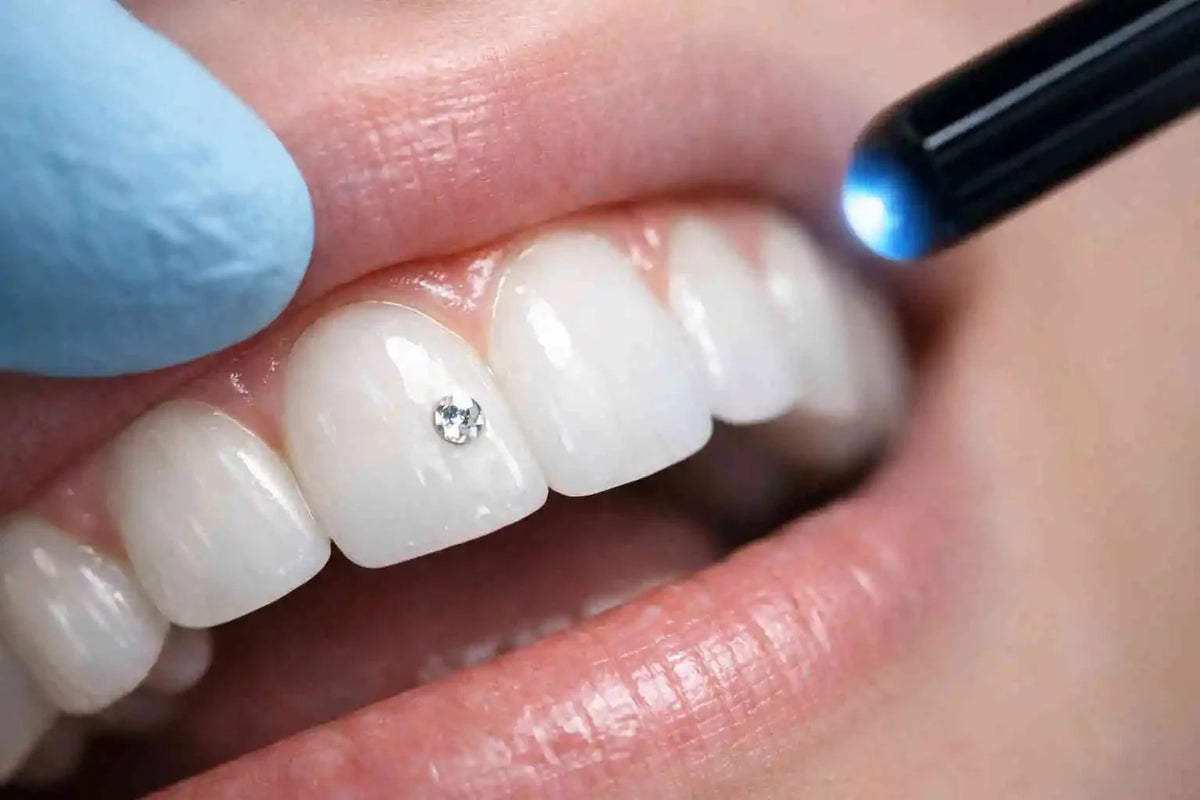
Quick answer: never use nail glue, super glue, strong household glue or domestic adhesive on a tooth. For tooth gems, the word “glue” often refers imprecisely to a system of dental products with different roles. No single product is automatically suitable for every situation.
This guide explains how to read and compare equipment. It does not provide a clinical protocol and does not replace a dentist’s advice or manufacturers’ instructions.
Why ordinary glues are excluded
Nail adhesives and household glues are not formulated or evaluated for enamel, saliva and oral tissues. They may complicate removal and expose the tooth or gum to damage. “Strong” or “long-lasting” is not a criterion for oral compatibility.
One system, several functions
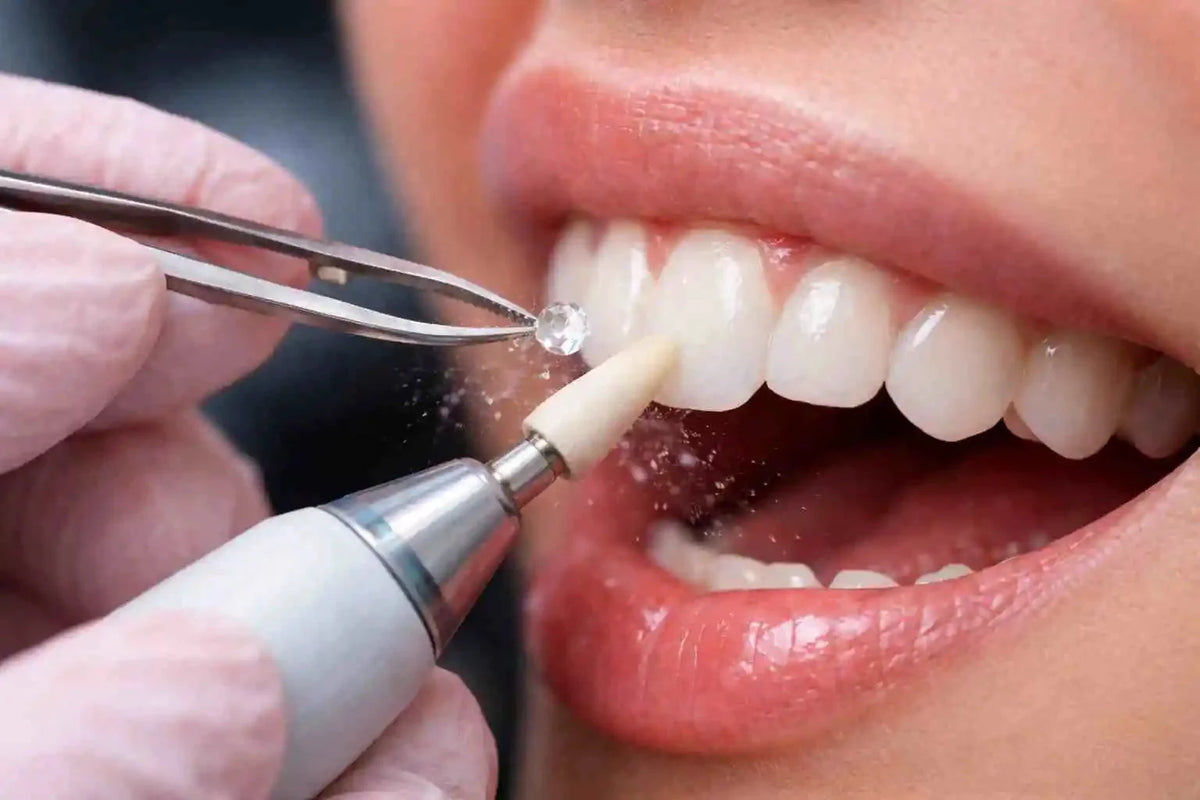
Depending on the intended system, surface preparation, bonding, the fixing material and light curing perform different functions. They should not replace one another or be mixed without checking the instructions.
- Intended use: the product clearly states its purpose and restrictions.
- Compatibility: the components and curing light are designed to work together.
- Traceability: batch, date and manufacturer can be identified.
- Instructions: storage, quantities, timing and precautions are available.
- Removal: the plan for removal and tooth inspection is considered beforehand.
To understand each category, read the application equipment guide.
The curing light is part of compatibility
A light-curing product should be paired with a light whose characteristics match the manufacturer’s directions. Output, wavelength, distance and exposure time should not be copied from another material. Uncertain curing is not corrected simply by adding more product.
Checklist before using a product
- ☐ Intended use on a tooth surface is clearly documented.
- ☐ Complete instructions are available and understood.
- ☐ Batch, date and storage can be verified.
- ☐ Compatibility with other components and the curing light is confirmed.
- ☐ No household adhesive is used as a substitute.
- ☐ The tooth shows no sign that warrants advice.
- ☐ Removal by a dentist is planned if needed.
Use each guide for its specific question
For a technical comparison of adhesive families, read the comparison of dental adhesives and products marketed as “para-dental”. For prevention, see hygiene and safety. The removal guide explains why removal should not be improvised.
Available products are grouped in application materials; being listed does not replace reading their instructions.
Frequently asked questions
Is there a universal tooth gem glue?
No. Think in terms of a compatible system and documented intended use, not the strongest glue.
Can nail glue be used just once?
No. It is not designed for the oral environment and does not become suitable because use is occasional.
Does long retention prove safety?
No. Retention alone says nothing about biocompatibility, enamel effects, hygiene or removal.
What if the gem becomes loose?
Avoid handling or pulling it off and ask a dentist to inspect the area and arrange removal.
Sources and limits
- American Dental Association: Oral Piercing/Jewelry
- American Academy of Pediatric Dentistry: oral jewelry policy
- Oral Health Foundation: Tooth gems and grillz
Tooth Gems World editorial content, updated September 4, 2026. Sources accessed September 4, 2026. Permitted uses and responsibilities vary by country; this content does not replace product instructions or dental advice.
Questions about a product or an order?
The Tooth Gems World team can help you check a product’s specifications, understand what a kit includes or locate an order. For health or treatment advice, speak to a dentist.
- Contact customer service through the form or live chat.
- Check delivery rates and estimated times and our payment methods.
- After ordering, find your purchases in your customer account or visit our Help Centre.


Leave a comment
This site is protected by hCaptcha and the hCaptcha Privacy Policy and Terms of Service apply.