
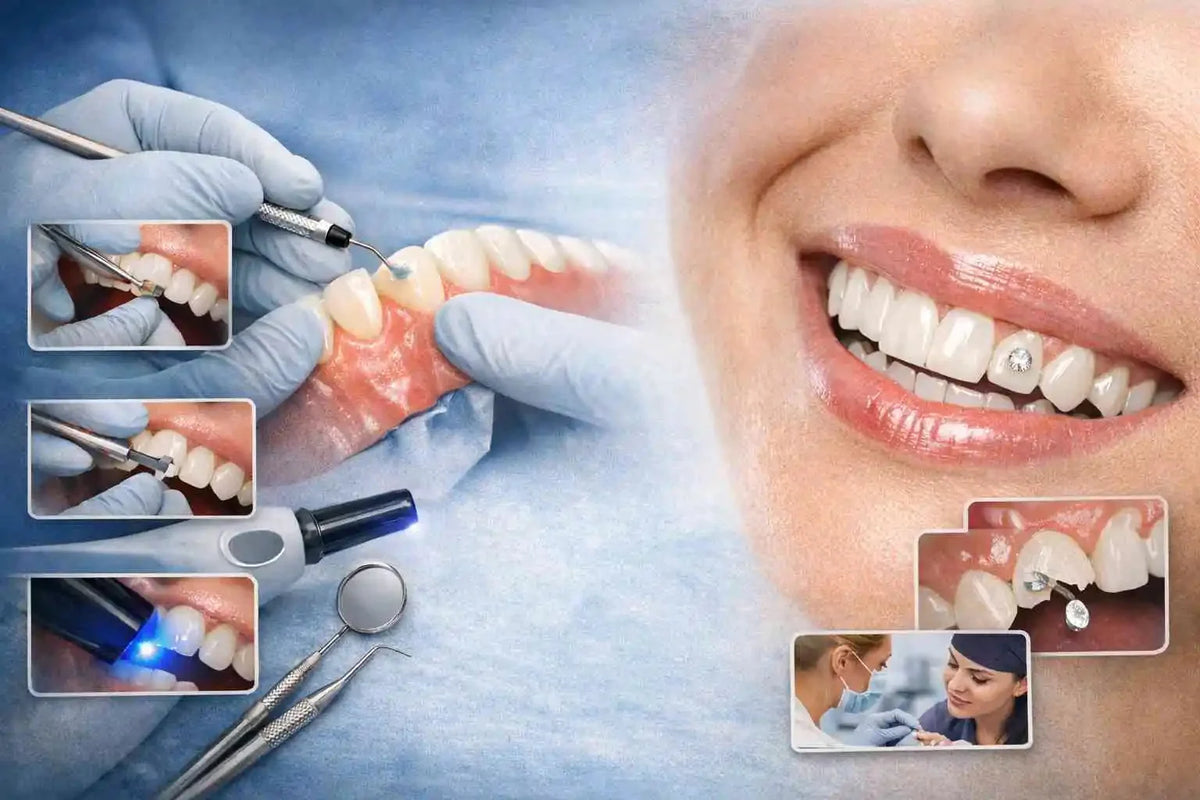
Quick answer: a reliable tooth-gem placement journey does not begin with bonding. It starts by checking oral health, the legal and professional framework, products and traceability. It ends with aftercare instructions, warning signs and a dentist-led removal route.
This page describes the checkpoints in a prudent journey. It does not replace a dental examination, manufacturer instructions or authorised professional training, and it does not provide a clinical procedure to copy.
The journey in seven checks
- Have the tooth and gums checked by a dentist.
- Confirm the legal framework, competence and insurance.
- Identify the gem, every product and the documented system.
- Prepare an environment and equipment suitable for contact with the mouth.
- Inform the person, obtain agreement and define stopping points.
- Follow applicable instructions strictly without improvised mixing.
- Complete final checks and provide aftercare, warnings and removal information.
1. Check the situation before considering placement
The Oral Health Foundation recommends speaking to a dentist first to understand the risks and check that teeth and gums are healthy. Postpone the plan if there is pain, unexplained sensitivity, bleeding, irritated gums, a lesion, an apparent crack, suspected decay, orthodontic appliances or recent dental care, and seek dental advice.
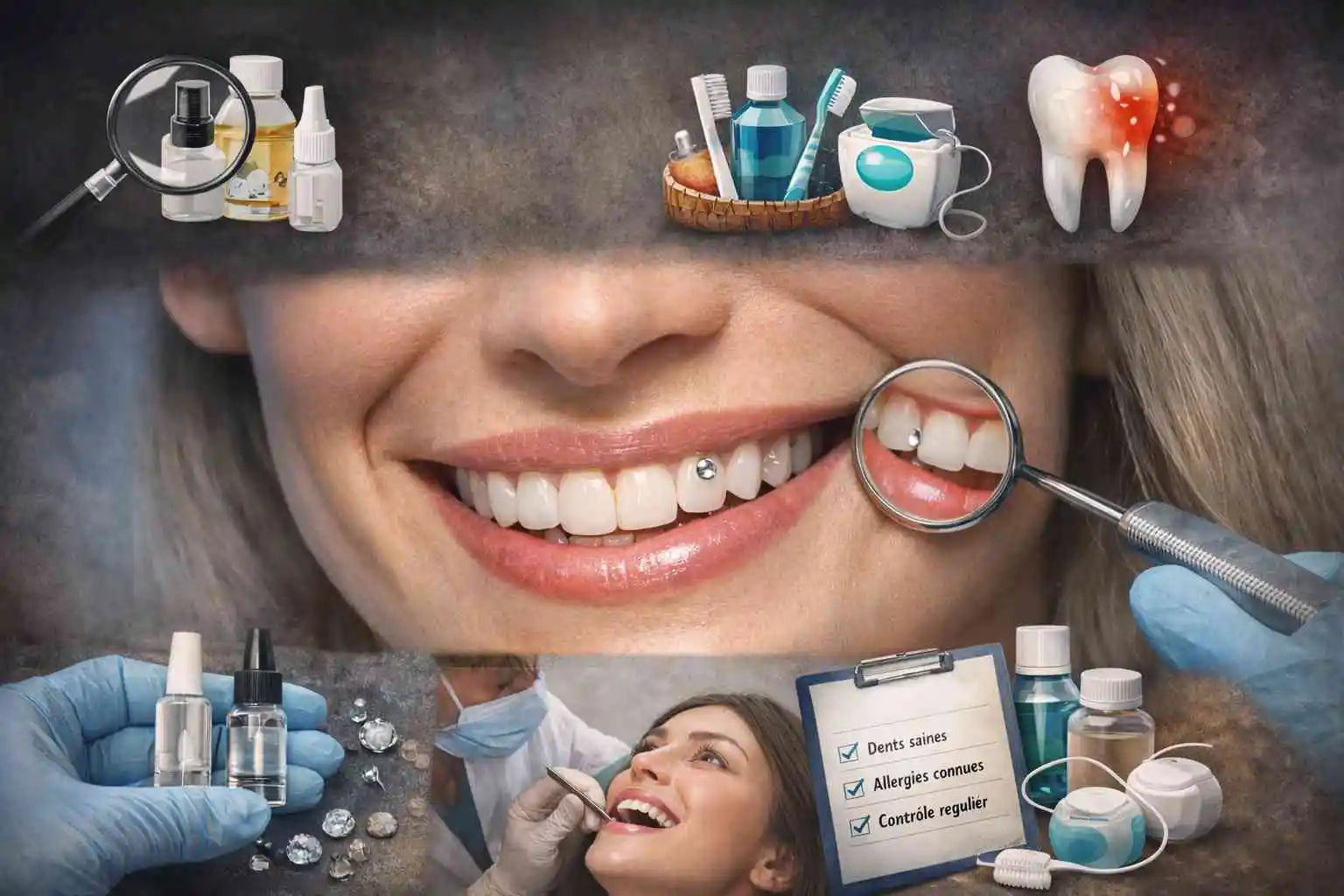
The absence of symptoms is not a diagnosis. The pre-placement checklist helps prevent these checks from being missed.
2. Confirm who may do what
Professions, reserved activities, insurance requirements and rules for minors vary by country. A private course certificate does not, by itself, create legal authorisation.
- Describe the exact activity to the relevant authority or adviser.
- Check the provider’s status and qualifications.
- Obtain confirmation that insurance covers the actual activity.
- Check local consent and information requirements.
Read the European regulatory guide and the provider guide.
3. Identify the system before opening products
The word “glue” can cover several functions. Before use, check for every product:
- the exact name, manufacturer and intended purpose;
- the intended user in the instructions;
- explicitly compatible components and devices;
- batch number, date and storage conditions;
- warnings and manufacturer-stated actions in case of a problem;
- limitations and the removal route.
Do not mix products, brands or lights because they look similar. The bonding-system comparison provides a checklist for reviewing the documentation.
4. Prepare the environment and prevent contamination
CDC Standard Precautions apply to dental health-care settings and are not European law for every activity. They nevertheless offer a useful reference: hand hygiene, appropriate protective equipment, correctly processed instruments and clinical surfaces cleaned or disinfected between people.
The work area should separate clean items, items in use and contaminated items. A single-use item is not reused. A reusable instrument needs a process suited to its category, material and manufacturer instructions.
Read the hygiene and safety guide.
5. Provide information before any manipulation
The person needs to understand the cosmetic nature of the gem, possible risks, limits on wear time, aftercare, warning signs and how removal will be handled. The American Dental Association advises against cosmetic tooth gems because of the increased risk of adverse health outcomes.
Information should not include a promise of “zero risk”, guaranteed wear or removal that is always consequence-free. Agreement does not replace legality, competence or product compliance.
6. During use: follow the system, not a generic tutorial
Preparation, application and curing conditions depend on the exact products and their instructions. A universal time or quantity published online cannot be applied to every product.
- Do not change the order or components described by the manufacturer.
- Do not use a product outside its stated purpose.
- Do not replace the light or its setting without documented compatibility.
- Discard any contaminated, expired or unidentifiable item.
- Stop if the required conditions cannot be maintained.
- Do not continue if pain, bleeding or an unusual reaction occurs.
A visually acceptable result does not prove that the system was used in accordance with its instructions.
7. Final checks, aftercare and removal
Final checks are not limited to whether the gem appears to stay in place. They also cover information provided, batch traceability, reported comfort, cleaning access and what to do if a problem occurs.
- Provide understandable aftercare instructions.
- Identify pain, persistent sensitivity, swelling, bleeding, a loose gem or difficulty cleaning as reasons for dental advice.
- Prohibit pulling, scraping and home reattachment.
- Plan removal and review by a dentist.
Use the aftercare guide and the removal guide.
When to stop or postpone
| Situation | Prudent decision |
|---|---|
| Painful tooth or gums | Postpone and seek dental advice |
| Product without batch or instructions | Do not use it |
| Unknown curing-light compatibility | Do not improvise |
| Unclear legal framework or insurance | Obtain confirmation before offering the service |
| Contamination or hygiene-process failure | Stop and replace or reprocess as required |
| Pain, bleeding or reaction during manipulation | Stop and refer to a health professional |
| Loose gem after placement | Do not pull or reattach; seek dental advice |
Common mistakes
- Starting without a dental check.
- Confusing commercial training with professional authorisation.
- Using household glue or an unidentified product.
- Mixing components without written compatibility.
- Treating the curing light as universal.
- Reusing a single-use item.
- Promising guaranteed wear or safety.
- Forgetting the aftercare and removal plan.
To analyse causes instead of hiding symptoms, read the equipment-mistakes guide.
Frequently asked questions
How long does placement take?
There is no universal duration for the appointment or wear. Products, instructions, context and required checks differ.
Should placement be painless?
Pain, burning, bleeding or an unusual reaction should not be normalised. Stop and seek dental advice.
How can you tell whether placement was successful?
Immediate retention is not enough. Consider system compliance, traceability, comfort, cleaning, information and follow-up.
Can a fallen gem be reattached?
Not automatically. The tooth, residue, product and cause need to be reassessed before any decision.
Who should remove a tooth gem?
The prudent option is a dentist, who can examine the tooth and any residue.
Sources and limitations
- American Dental Association: Oral Piercing/Jewelry
- American Academy of Pediatric Dentistry: oral jewellery policy
- Oral Health Foundation: Tooth gems and grillz
- CDC: standard precautions in dental settings
- CDC: instrument processing and sterilisation in dental settings
Sources checked on 4 September 2026. This overview is not a clinical protocol and does not replace manufacturer instructions, local rules or dental advice.
Questions about a product or an order?
The Tooth Gems World team can help you check a product’s specifications, understand what a kit includes or locate an order. For health or treatment advice, speak to a dentist.
- Contact customer service through the form or live chat.
- Check delivery rates and estimated times and our payment methods.
- After ordering, find your purchases in your customer account or visit our Help Centre.

Leave a comment
This site is protected by hCaptcha and the hCaptcha Privacy Policy and Terms of Service apply.