

Quick answer: to start with tooth gems, you should not buy too much equipment at random. It is better to begin with a simple base: suitable jewels, precision accessories, compatible consumables, a lamp if the protocol requires it, a clean workstation and clear aftercare advice. The goal is to build a reliable method before adding more complex designs.
This guide helps you understand which equipment to choose when starting without overbuying.
Contents
- What you really need to start
- Choosing your first tooth gems
- Understanding the role of accessories
- Application materials and compatible products
- Organizing the workstation
- Common beginner mistakes
- Starter checklist
- FAQ
What you really need to start
When starting, it is easy to want to buy everything: all sizes, all colors, all shapes and all accessories. In reality, it is better to begin with a controlled selection.
- A few classic tooth gem sizes.
- One or two bold shapes if the style requires it.
- Precision accessories.
- Clean and well-stored consumables.
- A clear method to apply, check and maintain the result.
Before working with a client for the first time, a training denture helps practise placement and product handling.
Choosing your first tooth gems
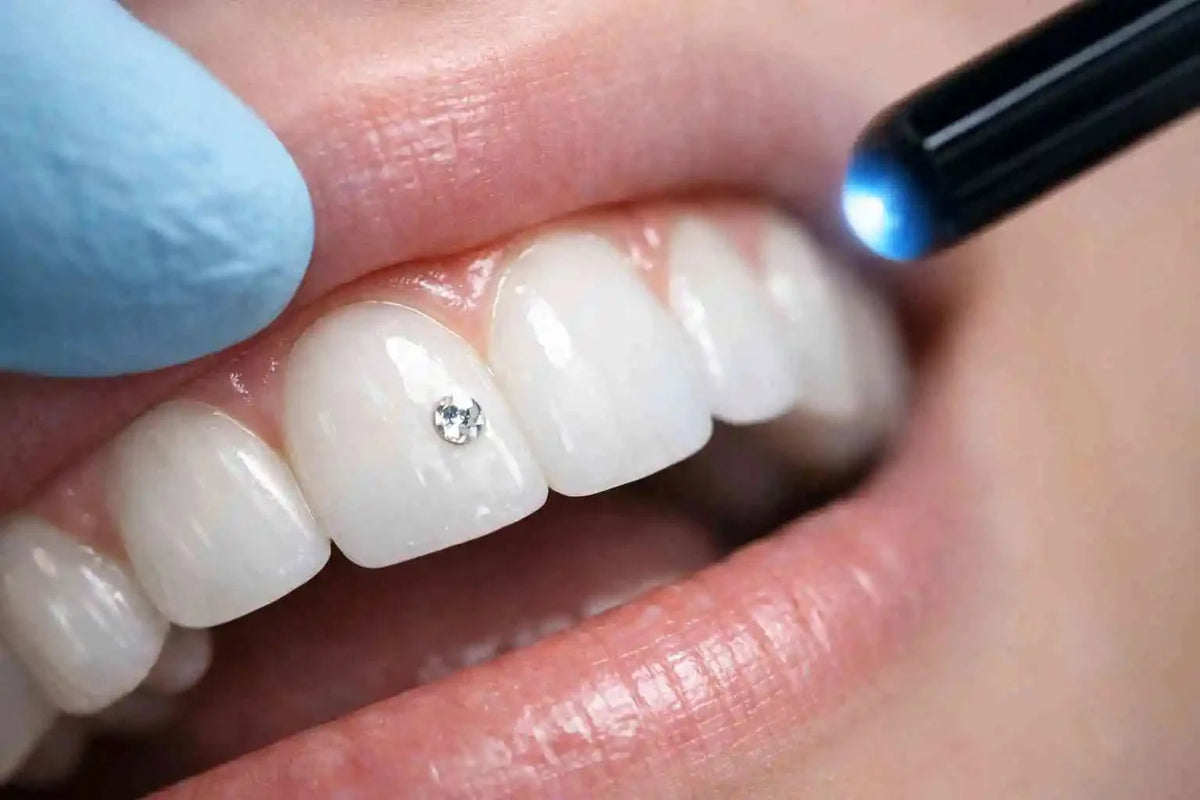
Clear crystals are often the most versatile for beginners. They allow simple, discreet applications that match different smiles.
Shapes and colors can be added gradually once technique and placement are more controlled.
- Crystal: classic and luminous choice.
- Small sizes: discreet result and easier to integrate.
- Shapes: useful to create a visual signature, but they require precision.
- Opals or colors: interesting for more creative designs.
Understanding the role of accessories
Accessories are not only used to “hold” the gem. They help work more cleanly, faster and with better precision.
- Micro-brushes help apply some products precisely.
- Cotton rolls or absorbent rolls help with isolation.
- A pick-up pencil makes jewel handling easier.
- A lamp is necessary only when required by the protocol used.
A good accessory reduces unnecessary handling and improves consistency.
Single-use micro-brushes are useful for removing excess product and maintaining precision.
Application materials and compatible products
Application materials must be compatible with the dental surface. Suitable products should never be replaced with household glue, nail glue or adhesives not designed for the mouth.
The product choice depends on the level, protocol and type of application. The goal is to work cleanly without improvising.
Organizing the workstation
A well-organized workstation helps avoid mistakes. Before starting, everything should be ready: jewels, accessories, consumables, lamp if needed, clean work surface and instructions available.
A stable routine helps build confidence and makes it easier to understand what works and what does not.
Common beginner mistakes
- Buying too many different products from the start.
- Choosing jewels that are too large for first applications.
- Using unsuitable products.
- Working without a clear method or order.
- Forgetting the importance of isolation and a dry area.
- Not checking placement before final bonding.
- Not sharing aftercare advice.
Starter checklist
- Start with a simple selection of gems.
- Choose sizes that are easy to place.
- Prepare all accessories before application.
- Use only compatible products.
- Keep a stable routine.
- Work on a clean and dry area.
- Check placement before final bonding.
- Share aftercare advice.
Recommended reading
FAQ
What equipment should you buy to start?
It is better to begin with a simple selection: a few classic tooth gems, precision accessories, compatible consumables and a clear method.
Should you buy many colors?
No. Colors can be added later. To start, clear crystals are usually more versatile.
Is a DIY kit enough to start?
A DIY kit can introduce you to a simple application, provided the instructions and limits of use are respected.
What is the main beginner mistake?
Trying to move too quickly into complex designs without mastering the basics: hygiene, placement, product quantity and aftercare.
When should you move to more advanced designs?
When simple applications become consistent, clean and comfortable, it makes more sense to add shapes, colors or compositions.
Conclusion
Starting with tooth gems requires method above all. A simple selection, a clean workstation, compatible products and a stable routine matter more than a large stock. Progress happens step by step, with precision and caution.


Leave a comment
This site is protected by hCaptcha and the hCaptcha Privacy Policy and Terms of Service apply.